Category: Blogs

Project Seagrass at Awel y Mor Primary

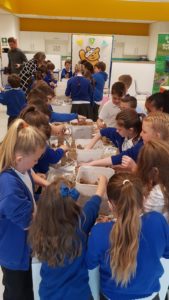
We were extremely excited to build up a relationship with Project Seagrass. Being asked to take part has enabled us to develop our skills and knowledge as staff to help progress with our own school project ‘AYM Project Plastic’. The children have absolutely loved this experience! They have gained lots

Read More »

Marine biology and me

It wasn’t a natural calling. It wasn’t a passion from birth. I was always going to be a baker until I was going to be a nurse, a psychologist, a social worker, a midwife, a nutritionist, a mathematician, etc, etc. So where did marine biology come in? Donning three wetsuits

Read More »

One man went to sow

Guest blog by Mike Furness about his experience as a volunteer during seagrass planting week. It was smelly; it was noisy; it was heavy; it was cold. It was buzzing, vibrant and invigorating. Overwhelmingly it was about camaraderie, enthusiasm and shared purpose, and all set on the beautiful Pembrokeshire coast.

Read More »

New life and new hope

Ah, the long awaited bank holiday weekend is almost here, but this time the circumstances are more than a little unusual. Instead of heading to the beach we will be staying at home, not just to look after ourselves but to support our NHS and it’s amazing staff. Easter is

Read More »

The Isolated Conservationist

You are not alone! We are all having to take a pause from our chaotic lives in the midst of the COVID-19 pandemic. We must support our health care services and the incredible frontline workers by staying at home. Our ocean optimism and motivation to protect our planet does not stop for

Read More »

Mosquito nets: Are they catching more fishes than insects?

Mosquito nets designed to prevent malaria transmission are used for fishing which may devastate tropical coastal ecosystems, according to a new scientific study. The researchers found that most of the fish caught using mosquito nets were smaller than a finger and potentially collect hundreds of individuals. Malaria is a serious

Read More »

Oceans Festival 2019

Oceans Festival was a day to celebrate work being carried out by scientists, educators, volunteers, artists and many more. There was a variety of stands all sharing the same passion for our oceans. With stalls selling sustainable and plastic free items to beautiful artwork of marine mammals as well as yummy

Read More »

Project Seagrass: A Year In Review 2018-2019

Richard Lilley Every year, as a charitable organisation, we have to write a report highlighting the previous 12 months activities. In our early days as a charity these seemed fairly straightforward, but as I sit here to write this, I find it very difficult to decided what to include. A

Read More »

Project Seagrass at Awel y Mor Primary

We were extremely excited to build up a relationship with Project Seagrass. Being asked to take part has enabled us to develop our skills and knowledge as staff to help progress with our own school project ‘AYM Project Plastic’. The children have absolutely loved this experience! They have gained lots of skills and knowledge. More importantly for us as a school, many of our pupils find it difficult to think about what they aspire to be, however since working with Project Seagrass many now talk about their aspirations to become marine biologists and are very eager for us to become part of more conservation projects. The children have gone from knowing nothing about seagrass to being very keen to ‘show off’ what they have learnt about the importance of seagrass and how we can help restore and maintain it for the sea environment. They get very excited when Project Seagrass (especially Evie) are coming into school and every visit has been fun and enjoyable so the children always want to know how long until their next visit! We can’t thank Project Seagrass enough for this experience and look forward to working together in the future. Vicky Hibben & Gemma Ness Awel y Mor Primary School    

Read More »

Marine biology and me

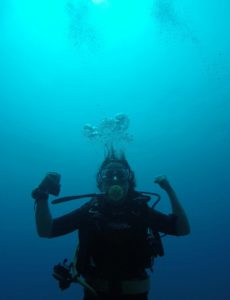
It wasn’t a natural calling. It wasn’t a passion from birth. I was always going to be a baker until I was going to be a nurse, a psychologist, a social worker, a midwife, a nutritionist, a mathematician, etc, etc. So where did marine biology come in? Donning three wetsuits and some scuba diving gear I jumped into Wraysbury quarry pit. The noise of Heathrow airport and a chaotic world disappeared, a peaceful adrenaline kicked in. I turned to check my buddy was ok but all I could see through the murky water was their hand. Was there a body attached to the hand? Was I going to survive my first attempt at scuba diving? Either way I was hooked. So, my many different career paths got put on hold, where I think they might just stay. Instead of university I packed my rucksack in search of dive sites. I saw the bright red lipstick of puffer fish in New Zealand. The manta rays and turtles of Fiji. The complete lack of life on the Great Barrier Reef. Where was the crunching of the parrot fish, the popping of the reefs? I’d been as a child to these psychedelic waters, yet now, 10 years on, the Great Barrier Reef was plain. I wanted to know more. Four years later I had ticked off a first-class (I still don’t believe it!) degree in Marine Biology with a year in industry (Project Seagrass!). Along the way I gained experience in the South African bush, of fieldwork on the UK coast, a boat driving license, tropical fieldwork in Jamaica, diving trips all around Wales as well as Belize, Portugal and Tenerife, all accumulating to a BSAC dive leader qualification and of course I gained a love for seagrass. Straight out of my last university exam I got lucky with a technician job for SEACAMS2 where I spent the summer on boats. I was frequently jumping in the sea to hand catch jellyfish, my face and hands tingling with the stings. We jotted up and down the Gower coastline working with echosounders, fishing nets and CPODS. The sun started to fade and as winter arrived I found myself up to my elbows in well over a thousand fish guts looking at Herring spawning stocks in west Wales. All that stink and I was ready to scooch off and away again- there’s too much ocean to explore to sit still. I swapped a fishy lab for the incredible fish life of the Indo-Pacific. I ticked off some major marine bucket list moments (think thresher sharks, oceanic manta rays, whale sharks, pygmy sea horses, wobbegongs and countless fish and invert species- Nudi’s are downright awesome!). Most importantly I ticked off my PADI dive master, where I gained a love for muck diving- the buzz of finding the tiniest most cryptic of critters. This time the travels were cut short but for good reason- Seagrass Ocean Rescue. Throughout school and university, I’ve worked various part time jobs, all of which related to kids or confectionary. This combined with my growing experience of the underwater world, I had the beginnings of the skill set needed to take a lead on the outreach of the project. Basically, I can clown around in front of kids and have so far persuaded nearing 2000 of them that seagrass is worth shouting about. That it’s worth them rolling up their sleeves to help us plant a new meadow. I can also make a mean chocolate brownie, perfect post seagrass dive treat. So here I am, working on a project full of ocean optimism with an energetic awe-inspiring team to plant a seagrass meadow. My other career paths stayed on hold. Was I right? Well, the only career advice I can offer is don’t rush, one day you’ll also realise that everything’s better at sea.

Read More »

#ScientistsOfSeagrass: From Farm to Seagrass Restoration

Sat in lockdown it’s hard not to reflect and think about life, and 2020 actually marks ten years since I left the small farm in the Welsh countryside to pursue my career. So, sit back and enjoy the career rollercoaster that has been the last ten years! It all started off at Bangor University where I studied Marine Biology. I’d wanted to do this for as long as I remember, I have always had a fascination with sharks, whales, fish, you know, the normal stuff for a teenager to be obsessed with… Even this had a rocky start however, I didn’t get the A-level grades I had hoped for, so had to make my case to the course director to let me in, which thankfully they did! August before heading to Bangor my welcome pack came with a prompt to sign into your IT account ahead of time to make sure it works… it didn’t. Several hours on the phone to various people, I wasn’t registered to go to university. Disaster. Another plea to the course director, who thankfully remember me, and they squeezed me in, and I got the last accommodation room (in a building which was demolished the next year!). Smooth sailing and I’ve not even left home yet. Though very hard work the next few years went off without a hitch, I even had time to work part time jobs at McDonalds, a pet shop, a bakery, as a cleaner, a café, pond maintenance and even pest control! I passed BSc (Hons) with a 2.1 but couldn’t find any jobs that I liked, so I made the decision to stay at Bangor and do their Marine Environmental Protection MSc. I worked 7 days a week for the summer of 2013 to pay for it at the pet shop, pest control and one of my favourite places I’ve worked Anglesey Sea Zoo. Working at the Sea Zoo was excellent, it was the first time I’d really had an opportunity to get close and familiar with UK species. What I learnt there still comes in useful today as much of my work involves fish ID. In a flash the summer was up, and I went back to only working at the pet shop and went into my MSc. I thought BSc was hard work, the MSc was intense! I worked five days a week at uni, and two to earn money, with only Christmas and Easter off! Nevertheless, I passed and was released out to the world! What’s the natural career for someone who’s just passed an MSc in environmental science? Marine Mammal Trainer, yep, I became a seal trainer, at the Rhyl Seaquarium. Maybe not a totally natural flow but it was a chance to work (£££!) with animals I really loved, in environment that promotes education and conservation of marine species. Another place that will remain close to my heart, not just as my first ‘proper’ job but for the opportunity to work close with fish and seals and learn about them in such a personal manner. All good things come to an end and it was time for me to move on, I became the senior aquarist at Skegness Aquarium in Lincolnshire, another fantastic opportunity to work with tropical species with a tank large enough to dive in! After several months I worked my way to the curator position; now responsible for the operation of the building! I learnt so many skills working in in aquaria, from plumbing to breeding sharks and seahorses. These positions gave me a chance to work so closely with a topic that had been a hobby for me for so many years (did I mention I has 20 fish tanks in my mums shed?) and allowed me to meet so many great people. I decided however that I wanted to work in a more active conservation role, using my scientific background. This led me back to the city I was born, Swansea! I became the Benthic Marine Biology Technician on the SEACAMS2 project. SEACAMS2 was an excellent opportunity as it is a multi-project project allowing me to experience an array of marine science disciplines, the primary projects I worked on were: • Seagrass Restoration Methodology • Methodology of Baited Remote Under Water Video Systems (BRUVS) in low visibility • Acoustic camera use (ARIS) • Benthic species settlement on artificial structures • Mapping of fish spawning grounds and fish population dynamics The key project was the seagrass restoration project! I was part of the team that developed a successful biodegradable seagrass restoration method. This in turn (along with obtaining my Dive Master qualification) gave me the experience to work as the technical lead on the Seagrass Ocean Rescue project (Supported by Project Seagrass, Sky Ocean Rescue and WWF). Though I do miss working at aquariums, nothing is more satisfying than stepping back and looking at the work that myself and the team I’m part of have achieved over the last year. We collected and planted 750,000 seagrass seeds, covering an area of 1.5Ha (about a rugby pitch and a half!). I’d like to thank my family, particularly my parents, for supporting me throughout, and still doing so! Also all my colleagues past and present, I know without such amazing people around me I would not have been able to get where I am today. Sam  

Read More »

One man went to sow

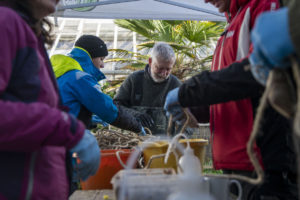
Guest blog by Mike Furness about his experience as a volunteer during seagrass planting week. It was smelly; it was noisy; it was heavy; it was cold. It was buzzing, vibrant and invigorating. Overwhelmingly it was about camaraderie, enthusiasm and shared purpose, and all set on the beautiful Pembrokeshire coast. At the end of February, I was privileged to be one of thirty or forty volunteers (the numbers varied daily) playing their individual parts in the climax act of a long-running, seagrass drama. We were going to help to sow a seagrass meadow, not just a small patch but a whole ‘field’. The logistics are daunting to think about; everything from feeding and accommodating the team to previously organising hundreds of school children to fill and tie 20,000 small bags on to 20km of ropes. Not to mention the harvesting and preparation of ¾ of a million seeds. An astounding effort. It would be wrong to say that everything ran flawlessly, but this is fieldwork and coping with the unexpected is part of the art behind the science, and the team coped magnificently. Immense teamwork both on land and at sea to get the seeds planted. I was first introduced to seagrass by taking too close an interest in my daughter’s marine biology studies. Her thesis involved endless hours of studying underwater video of seagrass beds and sometimes I was allowed to help. I don’t think that anyone could watch the multitude of life in a good sward without becoming an advocate for the importance of this vital habitat. So, when Evie, my daughter, first mentioned the meadow-sowing project and that volunteers were needed, I knew I had to be part of it. Arriving at Fort Dale on a crisp, blowy morning, with the wind at our backs, the smell wasn’t immediately apparent. The first impression was of organisation and industry; already half a dozen teams were bound together by their ropes, busily spooning seeds into pouches, topping them up, watering them and passing them on to the packer to carefully coil into a crate ready for soaking and dispatch to the boat team. Crates were rolling off the production line every few minutes, amid lots of banter and a backing track of 80’s pop classics. The productivity was impressive, but a quick glimpse into the temporary crate store quickly put this in perspective; this was a mammoth task. So, time to get stuck in. Mike getting ‘stuck in’. Quick introductions and we were underway. Conversation develops as the task gets familiar. “Where are you from? What has brought you here? Are you studying, employed, retired? What do you do?” Being thrown into a group of thirty or more would be difficult. Working four or five to a rope quickly establishes relationships – friendships – everyone knew the value of the task, everyone wanted to be there, there’s a shared purpose, a common goal, and everyone is freely giving of their time and enthusiasm. And with lots of jobs to do, there is an easy swapping of roles and ropes and before long you know everyone. For someone like me who spends his working life as a one-man band, the teamwork was a breath of fresh air. Ah, yes, the ‘fresh air’… Adding the smelly seeds. The seeds had been harvested in late summer and needed to spend several months rotting out of the harvested grass before being sown. By late February, they were ripe for planting and being kept in their own dedicated fridge. If you’ve ever walked through a geothermal area amidst the steam of fumaroles, you will know the smell that hits you when that fridge door is opened! It’s pungent. It’s sulphurous. It’s clinging. But, you know what, by the end of the day it virtually disappears. And on the morning of day two, when it hits you again, you begin to realise – that’s the smell of success, bring it on. Would I do it again, spend four days with a great bunch of people, in a beautiful location, working together to achieve something so important? Hmm, let me think about it! Mike

Read More »

New life and new hope

Ah, the long awaited bank holiday weekend is almost here, but this time the circumstances are more than a little unusual. Instead of heading to the beach we will be staying at home, not just to look after ourselves but to support our NHS and it’s amazing staff. Easter is a time to celebrate Spring, it’s the time of year when everything in nature is changing and promising new life and new hope. However you celebrate, I think we can all agree it’s a pretty eggciting time! One of the iconic images we associate with Spring are eggs! Eggs, wonderful aren’t they? From hen eggs to chocolate eggs you’d think you’ve seen it all, well what about cuttlefish eggs? Ooo want to know more? Eggcellent! Why don’t you check out this 2016 blog post from our Director Ben, I think you’ll agree it’s worth getting eggcited about! Eve

Read More »

The Isolated Conservationist

You are not alone! We are all having to take a pause from our chaotic lives in the midst of the COVID-19 pandemic. We must support our health care services and the incredible frontline workers by staying at home. Our ocean optimism and motivation to protect our planet does not stop for a lockdown. There are plenty of things that you can do from the safety of your home. Here are just a few ideas! Spring Clean! Perhaps you have some books, clothes or games you don’t want anymore? Staying at home is the perfect opportunity to have a big clear out. Once you’ve decluttered sell it at a car boot sale (when it’s safe to do so!). The money could then be used to catch a train to explore your nearest seagrass meadow or donate it to a conservation project, such as Project Seagrass. With the critical economic situation arising from COVID-19, it’s likely that many companies will have to take large budget cuts reducing what they can donate to small charities. Include your car in the clean-up- a lighter car uses less fuel! An Eco Makeover! Whilst having a spring clean try and identify products that could be switched for more eco-friendly ones- anything that goes down your drain or is chucked away will influence nature! Maybe switching cleaning products or try making your own?! How about making your own cosmetics such as shampoo bars or deodorant? Instead of buying new, maybe there’s an upcycling project you’ve always meant to do or get creative with handmade birthday presents. Why not try making eco-bricks or turning down the temperature of your washing machine? Seagrass Spotter! Take the extra time on your hands as an opportunity to go back through old holiday and beach snaps, there maybe some seagrass ones that could be uploaded to Seagrass Spotter to help build a global map of seagrass meadows. Encourage others to do the same! There are lots more citizen science projects you can get involved with like counting seabirds from your sofa. Plant Trees! For most working from home involves heavy internet use, so switch your search engine to ecosia and you’ll replant a forest in no time! Although Ecosia has had to reduce its tree planting during the pandemic, it plans to make up for lost time once safe to do so. Creative Conservationist! We have plenty of educational resources on the Project Seagrass website and shall be releasing more throughout social distancing. Check out our YouTube channel or our activities book. Maybe whilst you’re creating a rainbow coloured crab, you’ll have an eureka moment on other ways to Save Seagrass! This is also a chance to get artsy- maybe pick up those long forgotten paints for an underwater scene? Or work on those graphic design skills to make a seagrass awareness poster! Maybe you fancy yourself as a nature inspired poet or author? Eat for our seas! Enjoy having the time to try new things in the kitchen! Cutting down on your meat consumption is an easy way to help our earth. With less demand for meat comes less intensive farming, reducing the amount of excess nutrients from animal waste running in to our sea. The nutrients cause algal blooms which smother the seagrass, stopping sunlight reaching it for photosynthesis. Veggie grub also has a much lower carbon footprint. One of our favourite quick and easy comfort foods is roasted sweet potato and cauliflower tacos, you could even do a virtual taco night with friends! This recipe can easily be adapted to whatever’s left in the fridge- some peppers, onions or broccoli, maybe even mix in some leftovers from previous meals. Reducing food waste saves you money, takes pressure off our supply chains and helps protect our oceans- it’s a win all round! We’d love to hear of other ways people are keeping green, pop us a message and stay in touch whilst we’re all keeping distant. Best fishes, Evie!

Read More »

Mosquito nets: Are they catching more fishes than insects?

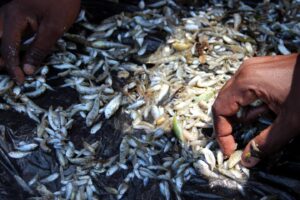
Mosquito nets designed to prevent malaria transmission are used for fishing which may devastate tropical coastal ecosystems, according to a new scientific study. The researchers found that most of the fish caught using mosquito nets were smaller than a finger and potentially collect hundreds of individuals. Malaria is a serious global health issue, killing nearly half a million people every year worldwide. Aid organisations like the Bill and Melinda Gates Foundation have invested in solutions to solve the crisis such as distributing hundreds of thousands of bed nets to protect people from mosquito bites carrying the virus. “Distributed mosquito nets are intended to be used for malaria protection, yet communities living in poverty use them for fishing, providing fresh concerns for already overfished coastal ecosystems, says,” Benjamin Jones, a director of Project Seagrass and PhD researcher at Stockholm University Department of Ecology, Environment and Plant Sciences. There are few studies that investigate how much fish mosquito-net fishing potentially harvests, although the use of mosquito nets for fishing is not a new phenomenon: “No evidence on the sheer amount of fish that these fisheries extract has been published that we are aware of. Gaining an understanding of these catches is vital if we are to manage such fisheries,” says Benjamin Jones. In Mozambique, each sweep of the mosquito net caught more than half of the average daily catch (2.4 kg a day) using traditional nets, by weight. But many of the fishes were very small, which means mosquito net fishers who cast their nets many times each day are removing a huge number juvenile fish to eat. Many of the species caught are important for food in the region when adults or help keep the seagrass ecosystems where they are found healthy. “The use of mosquito nets for fishing may contribute to less food availability, greater poverty and the loss of ecosystem functioning,” concludes Dr Richard Unsworth, a co-author and Lecturer in Marine Biology at Swansea University. Finding a solution to the problem is incredibly hard, but the researchers suggest the need for marine scientists, social scientists, health professionals and fishing communities to all work together. Laws imposed from governments make the use of mosquito nets for fishing illegal in some localities, however, such mechanisms are evidently insufficient because people still need food and “need re-thinking” according to the study. “We need to know why communities aren’t using these nets for intended use, and therefore we have to involve them, so they can be part of developing solutions to these challenges,” says Richard Unsworth. The team collected data at seagrass meadows by ten coastal villages in northern Mozambique. Identifying each fish species, the researchers recorded the weight of each fish group and the total catch, as well as age and where they are positioned in the food web.   The open access paper – “The perverse fisheries consequences of mosquito net malaria prophylaxis in East Africa” – is published on Monday 11th November at https://doi.org/10.1007/s13280-019-01280-0  

Read More »

Oceans Festival 2019

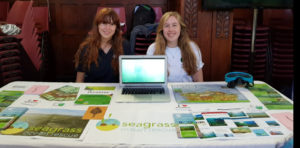
Oceans Festival was a day to celebrate work being carried out by scientists, educators, volunteers, artists and many more. There was a variety of stands all sharing the same passion for our oceans. With stalls selling sustainable and plastic free items to beautiful artwork of marine mammals as well as yummy vegan food there was something for everyone. There was a variety of stands all sharing the same passion for our oceans. Matt Brierley started the talks off on his new documentary he has been filming on the shark trade in the UK. It was shocking to find out that spiny dogfish which is critically endangered in the northern Atlantic is majority eaten in our fish and chip shops. These female sharks take 12 years to reach sexual maturity and has one of the longest gestation periods of any vertebrate, up to 2 years! Aside from this, illegal species are being brought into London fish markets, such as a juvenile scalloped hammerhead which is critically endangered and listed on CITES. It was terrifying to find out this happening in the UK. To move forward Matt wants “shark” to be labelled in fish and chips shops rather than the many other names it is given. This will make people more aware on what they are actually eating! A shocking fact I learnt at Scotland basking shark talk was that these sharks are consuming 440g of plastic every hour! There was a huge range of talks given from Lizzie Daly, Blue Ventures, Manta Trust and the Wave Project. This charity helps children who have had difficulties in their life and teaches them how to surf as a form of therapy. This massively helps build their confidence people, even changes the lives of these young people. This charity emphases how our oceans are used for a huge variety of purposes. To end the talks Andy Reid from Fins attached shared his involved with the charity and shared the legacy of Rob Stewart. This really touched me as when I was so inspired by Rob and his team growing up and how motivated he was to do everything he possibly can to save sharks and raise awareness of what is happening in the shark finning industry. His legacy carries on and with a new research vessel called Sharkwater which is traveling the globe to collect valuable marine data. On the stand it was great to hear such positive feedback from people about the project and to educate people about the importance of these incredible underwater plants. As well as seeing people wanting to get involved with the work being carried out by Project Seagrass. Overall there was a great sense of ocean optimism that spread across the festival, with people who are making a difference and to save our blue planet. Hopefully there will be more brilliant events like these. Thank you Oceans Festival 2019 for having us, and to everyone who volunteered. It was very fulfilling and enjoyable day! Thank you for reading. Issy Inman

Read More »

Intership Reflections – An introduction to Underwater Gardening!

Hello, I am Issy, a new intern at Project Seagrass. I just wanted to share with you a quick update with what I have been involved in so far! My first day started at Porthcawl beach, with two groups of excited primary school children. Here, in small groups, marine animals were built using natural material found along the beach. It was great to see how enthusiastic and engaged the kids were, some who rarely get to go to the beach. Inspiring the next generation is a vital for both raising awareness of the importance of our oceans, and for creating a passion and love for our oceans. After a week of getting settled, I was lucky to go to Falmouth with Evie Furness to start the picking of the seeds for the Seagrass Ocean Rescue project. We were showing a group of volunteer SCUBA divers what the seeds looked like, and how to collect them. It was a very enjoyable experience and I met some lovely people. It was also my first time snorkelling in seagrass meadows, I was taken back on how beautiful the Cornish coast is, and how and clear the water in seagrass meadows can be! The meadows I snorkelled in were huge and it felt like you could get lost in them. Shortly after Cornwall I joined the rest of the team in north Wales where the main picking was being held. Alex and I would go snorkelling collecting the seeds while the rest of the team went scuba diving. We would spend up to an hour and half in the water, I found it was peaceful and very therapeutic collecting the seeds, it was like being an underwater gardener! As seagrass being a nursey ground there was a range of fish species present including a greater pipefish. During our time in North Wales we were lucky to have teams from our partners Sky Ocean Rescue and WWF come and film the work being carried out here. This was a thrilling experience, and nice to see a buzz about the project from the public. It is vital to raise awareness of seagrass and its importance to the ecosystem as part of the issue conservation has not gone ahead is the lack of knowledge and understanding to the general public. Sky Ocean Rescue and WWF have been amazing at shinning the spotlight on seagrass. This will hopefully encourage more projects like these to go ahead in the future. Immediately after our trip to north Wales, Alex and I went back to Falmouth for a shore dive so more volunteer divers could get involved with the picking. There was also a BBQ to raise money DDRC Health in Plymouth as well as baby lobsters being released into the seagrass meadows from national lobster hatchery. It was great to see so many people involved and from a variety of ages, all willing to give up there Sunday afternoons to help with this project. Finally, another trip back to North wales for Seagrass-Watch. This is a scheme to monitor meadows across the globe to check the health and early signs for any degradation. Waking up at 3am in order to work with the low tide is fairly typical start time for a marine biologist, and watching the sunrise was magical – completely worth the early start! Over the couple of months it has been nonstop, I have met so many wonderful people and I have loved getting a hands on experience with the field work on such an important project. It has opened my eyes to how these restoration projects across the globe requires so much effort and hard work from many volunteers and workers but how fulfilling and worthwhile it is. I am looking forward to what the rest of the year has in store. I would like to give and big thank you to everyone who has helped with this project so far. Thank you for reading. Issy

Read More »

Project Seagrass: A Year In Review 2018-2019

Richard Lilley Every year, as a charitable organisation, we have to write a report highlighting the previous 12 months activities. In our early days as a charity these seemed fairly straightforward, but as I sit here to write this, I find it very difficult to decided what to include. A good sign for seagrass! Anyway, this is my take on our work for the 12 months from April 2018 to March 2019. April 2018 April 2018 seems like a long time ago now, but our financials year kicked off with Laura attending “A new post-2020 biodiversity agenda – the communications challenge” at the University of Cambridge. Part of this was the Cambridge Conservation Initiative’s Panel Discussion on Setting a new post-2020 biodiversity agenda. The 2-hour lecture/interactive question and answer session focused on what scientists and the world needs to do ahead of the 2020 Beijing Biodiversity Conference (which many hope will have the same impact on biodiversity as the Paris agreement has had on climate change). May 2018 In May Richard and Leanne, in collaboration with Dr Lina Mtwana Nordlund of Stockholm University, published the first quantitative global evidence on the significant roles that seagrasses play in world fisheries. This was an timely study that made explicit the link between global fisheries production and seagrass meadows, with the paper getting some good coverage on the BBC and leading to a subsequent letter that was sent to the European Union and British Government. May was also when the Amgueddfa Genedlaethol Caerdydd (National Museum Cardiff) hosted Project Seagrass as we celebrated the ‘Year Of The Sea’ in Wales! Many seahorses, cod, cuttlefish and crabs were coloured in with Evie and Leanne manning the stands for the event. Evie and Leanne at the National Museum, Cardiff celebrating Wales “Year of the Sea” June 2018 The International Seagrass Biology Workshop series is the biennial lead event of the World Seagrass Association. In June 2018, the 13th ISBW was held in at the National University of Singapore, Singapore. “Translating Science into Action” was the overarching theme for ISBW13 (a theme I think we can all get behind), with this year’s theme motivated by the ever-important need for effective communication of seagrass science amongst scientists, managers and practitioners. Ben (who had literally just move to Stockholm to undertake his PhD at Stockholm University) joined Richard and Leanne at the Indo-Pacific Seagrass Network workshop which focussed on assessing the value of seagrass meadows for supporting livelihoods and food security across the Indo-Pacific. Benjamin Jones showing how Baited Remote Underwater Video can be used to record species abundance and diversity. We left the conference feeling that the immediate challenge is to better develop and implement science-based seagrass conservation and restoration policies and protocols that will help put new science into practice. Immediately following ISBW13 was IMCC5. The 5th International Marine Conservation Congress in Kuching, Sarawak 24-29 June, 2018 was a brilliant conference. With over 700 marine conservation professionals and students in attendance. In my opinion, IMCC is the most important international event for anyone involved in marine conservation. This year’s event was the beautiful city of Kuching in Sarawak, and the conference brought together marine conservationists from many walks of life including but not limited to marine conservation scientists, practitioners, teachers, policy makers, and journalists. As I have to pick a highlight for Project Seagrass, it would have to be our workshop at the first International Marine Kids Congress, organized and led by qualified science instructors, IMKC ran along IMCC5 and engaged 30 school-aged children (ages 7 through 14) in science education, marine biology, environmental conservation, and experiential learning! For our part we enjoyed creating a seagrass meadow (see picture) and sharing with these young minds, all of the fantastic animals that live or rely on seagrass meadows! A fantastic group of kids learning about the wonders of seagrass at IMCC5. The next IMCC event (IMCC6) is in Kiel, Germany in August 2020. So, join us all in the heart of Europe as we come together to help “Make Marine Science Matter!” July 2018 After an exceptionally busy June, the month of July was a comparatively quiet for the Project Seagrass team! That said, we recorded another great podcast with Andrew Lewin for the fantastic Speak Up For Blue. In Scotland myself and Lauren Clayton attend the ‘Round The Pier Day’ Harbour Celebrations in Ullapool for some further seagrass awareness raising activities and in England and Wales a big focus for the month was our response to the consultation on the third tranche of MCZ designations. Finally, the 29th of July was our 5th Birthday, a significant milestone for us. August 2018 Our work in August celebrates the contributions to Project Seagrass of Oliver Dalby. Oliver’s project investigated the motivations, benefits, barriers and changes in knowledge associated with taking part in seagrass citizen science projects, specifically SeagrassSpotter and Seagrass-Watch, which he followed up with a popular blog post ‘Seagrass citizen science: investigations into a potential seagrass saviour’ September 2018 Equally, in September a highlight was hearing about the work of intern Isadora Sinha. Isadora’s project concentrated on analysis of the demographics of current SeagrassSpotter users, which has never been investigated before. The demographics of users are of particular importance as we want to ensure that SeagrassSpotter is used by citizens of all ages and professions, not solely by researchers. Her work helped us to think about how best to make SeagrassSpotter accessible and known to the wider public and has led to changes in the app which are currently being implemented. Isadora wrote a blog on her Project Seagrass experience. October 2018 Beyond our annual Autumn Survey in Porthdinllaen (this time we were out at 03:30am in the snow wind and hail!) October was a relatively quiet month. We survey the seagrass meadow at Portdinllaen four times a year (Spring, Summer, Autumn and Winter) using standard Seagrass-Watch methods. November 2018 In November Richard and Leanne wrote with colleagues a challenging piece of The Conversation suggesting that Tropical marine conservation needs to change as coral reefs decline. The article highlights that with a heavy heart we are now at a marine conservation crossroads with all paths looking precarious at best. December 2018 We kicked off December with our annual advent seagrass

Read More »