Tag: restoration

Fauna return rapidly in planted seagrass meadows, study shows

A study of eelgrass meadows planted by researchers from the University of Gothenburg shows that fauna return rapidly once the eelgrass has started to grow. Already after the second summer, the biodiversity in the planted meadow was almost the same as in old established eelgrass meadows. Eelgrass meadows have declined

Read More »

One man went to sow

Guest blog by Mike Furness about his experience as a volunteer during seagrass planting week. It was smelly; it was noisy; it was heavy; it was cold. It was buzzing, vibrant and invigorating. Overwhelmingly it was about camaraderie, enthusiasm and shared purpose, and all set on the beautiful Pembrokeshire coast.

Read More »

A Glimmer of Hope for Seagrass in the Wakatobi National Park?

Back in December 2015 I spent a couple of weeks in the Wakatobi, Indonesia, initiating phase II of the Wakatobi Seagrass Program. This seeks to build on work carried out though a previous project “Recognising the role of seagrass meadows in food security: re-prioritising the marine conservation agenda” (2011-2014), which

Read More »

Restoring our Damaged Seagrass Meadows

When you think about areas requiring bold initiatives to protect the environment, the small Welsh costal village of Porthdinllaen might not be the first place that comes to mind, and with only two dozen buildings and a miniscule population you might find it surprising that the environment there is under

Read More »

Fauna return rapidly in planted seagrass meadows, study shows

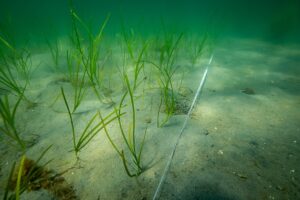
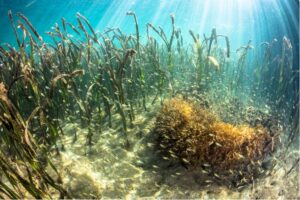
A study of eelgrass meadows planted by researchers from the University of Gothenburg shows that fauna return rapidly once the eelgrass has started to grow. Already after the second summer, the biodiversity in the planted meadow was almost the same as in old established eelgrass meadows. Eelgrass meadows have declined heavily in southern Bohus county in recent decades and in many places have disappeared altogether. Researchers at the University of Gothenburg have been working on the restoration of eelgrass meadows for twelve years. These meadows are important for biodiversity, as the eelgrass serves as habitat or nursery for young cod, crabs and shrimps for example. In a new study, the researchers have evaluated how rapidly replanted eelgrass gets populated by various invertebrates. The study has been going on for over two years in a bay near Gåsö island just west of Skaftö in Bohus county, and the findings are very positive. The researchers counted the abundance of invertebrates that live or burrow in bottom sediments or on the surface of bottom sediments. Size less important “The recolonization has been very rapid. After the first three-month growing season, up to 80 percent of the invertebrates had returned to the newly planted eelgrass,” says Eduardo Infantes, marine biologist at the University of Gothenburg. During the summer in 2019, the researchers planted the eelgrass shoots in four test plots of different sizes on the seabed, and with different spacing between the shoots. According to the researchers’ observations in autumn 2020, size has played less of a role in the recovery of biodiversity in the eelgrass meadows. In fact, even if the eelgrass has not had time to grow to the same density as in an established eelgrass meadow, the biodiversity is similar after only two growing seasons as in a reference area of preserved eelgrass in the same bay. Even smaller patches embedded within larger restoration plots showed good results. Their findings were reported in the journal Restoration Ecology. Can save money “This is good news for future restorations and new plantings of eelgrass meadows. We can plant new smaller plots with fewer shoots and this saves money because this is an expensive method for restoring biodiversity on the seabed,” says Eduardo Infantes. Eelgrass meadows have multiple functions that make it imperative to protect them. In addition to their important role in the coastal ecosystem, eelgrass roots bind the sediment and prevent erosion and limit resuspension of sediment in the water.   More information: Karine Gagnon et al, Rapid faunal colonization and recovery of biodiversity and functional diversity following eelgrass restoration, Restoration Ecology (2023). DOI: 10.1111/rec.13887

Read More »

Why saving the world’s seagrass is part of the most important to-do list in the history of humankind

“The downward trajectory of the world’s seagrass meadows must be reversed if we are to fight the planetary crisis” say leading seagrass scientists. The United Nations Sustainable Development Goals have recently been described as “the most important to-do list in the history of humankind”. Scientists from Project Seagrass and Swansea University have this week published a unique review that demonstrates how this “To-Do List” of Sustainable Development Goals provides a blueprint for achieving the net recovery of seagrass ecosystems. Conserving and restoring seagrass meadows contributes to achieving 16 out of the 17 Sustainable Development Goals. Recognising this wide role of seagrass meadows in helping achieve humanity’s ‘to-do list’ and thinking beyond their value in carbon sequestration and storage is critical to achieving the recovery of these degraded ecosystems. The call for urgent action comes after a review into the status of seagrass ecosystems and the major ecological role that they play in the coastal environment published in the leading academic journal Science and written by experts at the marine conservation charity Project Seagrass and Swansea University. Seagrass meadows are being increasingly looked to as a climate solution. However, seagrass ecosystems are sensitive to stressors and remain threatened across the globe. These degraded seagrass ecosystems are less effective at supporting biodiversity and tackling climate change. The authors state “Society needs to create meaningful pathways to net gain at local to global scales. Bold steps are needed through improved legal instruments to halt damaging factors such as bottom trawling, prevent use of damaging boating activities and to apportion responsibility for poor water quality that is causing the slow death of seagrass globally”. By recognising that seagrass meadows contribute to finding solutions to global problems such as food insecurity, water quality, wellbeing and gender equality, as well as the more well known issue such as biodiversity loss and climate change there becomes a more holistic view as to the benefits of taking large cumulative levels of action at local, regional and global scales. We need local and regional authorities to create a baseline of where seagrasses are now, where they used to be and where in the future they could be allowed to recover and be restored to get seagrass on the path to recovery. This needs to occur within the next decade if we are to fight climate change, to fight the biodiversity crisis, protect our coastlines and maintain global food security. Richard Unsworth (lead author) said “The world needs to rethink the management of our coastal environment that includes realistic compensation and mitigation schemes that not only prevent damage, but also drive the restoration, enhancement and creation of seagrass habitat. We also need a major shift in how we perceive the status of our marine environment by examining historical information, not just recent ecological baselines”. Ben Jones, a fellow author of the study added, “It is vital to work collaboratively as it is only through utilising scientific environmental studies and working as cogs in a global partnership for seagrass that meaningful change can happen”. Seagrass conservation faces substantial ecological, social and regulatory barriers and requires strong cross-sectoral partnerships to be put on the path to recovery. Identifying the solutions to seagrass conservation and restoration has never been more urgent and is critical to fight the planetary emergency. This can be achieved by using the Sustainable Development Goals as a blueprint towards recovery. Read the paper here.

Read More »

#ScientistsOfSeagrass: From Farm to Seagrass Restoration

Sat in lockdown it’s hard not to reflect and think about life, and 2020 actually marks ten years since I left the small farm in the Welsh countryside to pursue my career. So, sit back and enjoy the career rollercoaster that has been the last ten years! It all started off at Bangor University where I studied Marine Biology. I’d wanted to do this for as long as I remember, I have always had a fascination with sharks, whales, fish, you know, the normal stuff for a teenager to be obsessed with… Even this had a rocky start however, I didn’t get the A-level grades I had hoped for, so had to make my case to the course director to let me in, which thankfully they did! August before heading to Bangor my welcome pack came with a prompt to sign into your IT account ahead of time to make sure it works… it didn’t. Several hours on the phone to various people, I wasn’t registered to go to university. Disaster. Another plea to the course director, who thankfully remember me, and they squeezed me in, and I got the last accommodation room (in a building which was demolished the next year!). Smooth sailing and I’ve not even left home yet. Though very hard work the next few years went off without a hitch, I even had time to work part time jobs at McDonalds, a pet shop, a bakery, as a cleaner, a café, pond maintenance and even pest control! I passed BSc (Hons) with a 2.1 but couldn’t find any jobs that I liked, so I made the decision to stay at Bangor and do their Marine Environmental Protection MSc. I worked 7 days a week for the summer of 2013 to pay for it at the pet shop, pest control and one of my favourite places I’ve worked Anglesey Sea Zoo. Working at the Sea Zoo was excellent, it was the first time I’d really had an opportunity to get close and familiar with UK species. What I learnt there still comes in useful today as much of my work involves fish ID. In a flash the summer was up, and I went back to only working at the pet shop and went into my MSc. I thought BSc was hard work, the MSc was intense! I worked five days a week at uni, and two to earn money, with only Christmas and Easter off! Nevertheless, I passed and was released out to the world! What’s the natural career for someone who’s just passed an MSc in environmental science? Marine Mammal Trainer, yep, I became a seal trainer, at the Rhyl Seaquarium. Maybe not a totally natural flow but it was a chance to work (£££!) with animals I really loved, in environment that promotes education and conservation of marine species. Another place that will remain close to my heart, not just as my first ‘proper’ job but for the opportunity to work close with fish and seals and learn about them in such a personal manner. All good things come to an end and it was time for me to move on, I became the senior aquarist at Skegness Aquarium in Lincolnshire, another fantastic opportunity to work with tropical species with a tank large enough to dive in! After several months I worked my way to the curator position; now responsible for the operation of the building! I learnt so many skills working in in aquaria, from plumbing to breeding sharks and seahorses. These positions gave me a chance to work so closely with a topic that had been a hobby for me for so many years (did I mention I has 20 fish tanks in my mums shed?) and allowed me to meet so many great people. I decided however that I wanted to work in a more active conservation role, using my scientific background. This led me back to the city I was born, Swansea! I became the Benthic Marine Biology Technician on the SEACAMS2 project. SEACAMS2 was an excellent opportunity as it is a multi-project project allowing me to experience an array of marine science disciplines, the primary projects I worked on were: • Seagrass Restoration Methodology • Methodology of Baited Remote Under Water Video Systems (BRUVS) in low visibility • Acoustic camera use (ARIS) • Benthic species settlement on artificial structures • Mapping of fish spawning grounds and fish population dynamics The key project was the seagrass restoration project! I was part of the team that developed a successful biodegradable seagrass restoration method. This in turn (along with obtaining my Dive Master qualification) gave me the experience to work as the technical lead on the Seagrass Ocean Rescue project (Supported by Project Seagrass, Sky Ocean Rescue and WWF). Though I do miss working at aquariums, nothing is more satisfying than stepping back and looking at the work that myself and the team I’m part of have achieved over the last year. We collected and planted 750,000 seagrass seeds, covering an area of 1.5Ha (about a rugby pitch and a half!). I’d like to thank my family, particularly my parents, for supporting me throughout, and still doing so! Also all my colleagues past and present, I know without such amazing people around me I would not have been able to get where I am today. Sam  

Read More »

One man went to sow

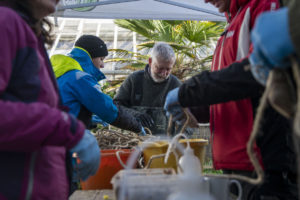
Guest blog by Mike Furness about his experience as a volunteer during seagrass planting week. It was smelly; it was noisy; it was heavy; it was cold. It was buzzing, vibrant and invigorating. Overwhelmingly it was about camaraderie, enthusiasm and shared purpose, and all set on the beautiful Pembrokeshire coast. At the end of February, I was privileged to be one of thirty or forty volunteers (the numbers varied daily) playing their individual parts in the climax act of a long-running, seagrass drama. We were going to help to sow a seagrass meadow, not just a small patch but a whole ‘field’. The logistics are daunting to think about; everything from feeding and accommodating the team to previously organising hundreds of school children to fill and tie 20,000 small bags on to 20km of ropes. Not to mention the harvesting and preparation of ¾ of a million seeds. An astounding effort. It would be wrong to say that everything ran flawlessly, but this is fieldwork and coping with the unexpected is part of the art behind the science, and the team coped magnificently. Immense teamwork both on land and at sea to get the seeds planted. I was first introduced to seagrass by taking too close an interest in my daughter’s marine biology studies. Her thesis involved endless hours of studying underwater video of seagrass beds and sometimes I was allowed to help. I don’t think that anyone could watch the multitude of life in a good sward without becoming an advocate for the importance of this vital habitat. So, when Evie, my daughter, first mentioned the meadow-sowing project and that volunteers were needed, I knew I had to be part of it. Arriving at Fort Dale on a crisp, blowy morning, with the wind at our backs, the smell wasn’t immediately apparent. The first impression was of organisation and industry; already half a dozen teams were bound together by their ropes, busily spooning seeds into pouches, topping them up, watering them and passing them on to the packer to carefully coil into a crate ready for soaking and dispatch to the boat team. Crates were rolling off the production line every few minutes, amid lots of banter and a backing track of 80’s pop classics. The productivity was impressive, but a quick glimpse into the temporary crate store quickly put this in perspective; this was a mammoth task. So, time to get stuck in. Mike getting ‘stuck in’. Quick introductions and we were underway. Conversation develops as the task gets familiar. “Where are you from? What has brought you here? Are you studying, employed, retired? What do you do?” Being thrown into a group of thirty or more would be difficult. Working four or five to a rope quickly establishes relationships – friendships – everyone knew the value of the task, everyone wanted to be there, there’s a shared purpose, a common goal, and everyone is freely giving of their time and enthusiasm. And with lots of jobs to do, there is an easy swapping of roles and ropes and before long you know everyone. For someone like me who spends his working life as a one-man band, the teamwork was a breath of fresh air. Ah, yes, the ‘fresh air’… Adding the smelly seeds. The seeds had been harvested in late summer and needed to spend several months rotting out of the harvested grass before being sown. By late February, they were ripe for planting and being kept in their own dedicated fridge. If you’ve ever walked through a geothermal area amidst the steam of fumaroles, you will know the smell that hits you when that fridge door is opened! It’s pungent. It’s sulphurous. It’s clinging. But, you know what, by the end of the day it virtually disappears. And on the morning of day two, when it hits you again, you begin to realise – that’s the smell of success, bring it on. Would I do it again, spend four days with a great bunch of people, in a beautiful location, working together to achieve something so important? Hmm, let me think about it! Mike

Read More »

Intership Reflections – An introduction to Underwater Gardening!

Hello, I am Issy, a new intern at Project Seagrass. I just wanted to share with you a quick update with what I have been involved in so far! My first day started at Porthcawl beach, with two groups of excited primary school children. Here, in small groups, marine animals were built using natural material found along the beach. It was great to see how enthusiastic and engaged the kids were, some who rarely get to go to the beach. Inspiring the next generation is a vital for both raising awareness of the importance of our oceans, and for creating a passion and love for our oceans. After a week of getting settled, I was lucky to go to Falmouth with Evie Furness to start the picking of the seeds for the Seagrass Ocean Rescue project. We were showing a group of volunteer SCUBA divers what the seeds looked like, and how to collect them. It was a very enjoyable experience and I met some lovely people. It was also my first time snorkelling in seagrass meadows, I was taken back on how beautiful the Cornish coast is, and how and clear the water in seagrass meadows can be! The meadows I snorkelled in were huge and it felt like you could get lost in them. Shortly after Cornwall I joined the rest of the team in north Wales where the main picking was being held. Alex and I would go snorkelling collecting the seeds while the rest of the team went scuba diving. We would spend up to an hour and half in the water, I found it was peaceful and very therapeutic collecting the seeds, it was like being an underwater gardener! As seagrass being a nursey ground there was a range of fish species present including a greater pipefish. During our time in North Wales we were lucky to have teams from our partners Sky Ocean Rescue and WWF come and film the work being carried out here. This was a thrilling experience, and nice to see a buzz about the project from the public. It is vital to raise awareness of seagrass and its importance to the ecosystem as part of the issue conservation has not gone ahead is the lack of knowledge and understanding to the general public. Sky Ocean Rescue and WWF have been amazing at shinning the spotlight on seagrass. This will hopefully encourage more projects like these to go ahead in the future. Immediately after our trip to north Wales, Alex and I went back to Falmouth for a shore dive so more volunteer divers could get involved with the picking. There was also a BBQ to raise money DDRC Health in Plymouth as well as baby lobsters being released into the seagrass meadows from national lobster hatchery. It was great to see so many people involved and from a variety of ages, all willing to give up there Sunday afternoons to help with this project. Finally, another trip back to North wales for Seagrass-Watch. This is a scheme to monitor meadows across the globe to check the health and early signs for any degradation. Waking up at 3am in order to work with the low tide is fairly typical start time for a marine biologist, and watching the sunrise was magical – completely worth the early start! Over the couple of months it has been nonstop, I have met so many wonderful people and I have loved getting a hands on experience with the field work on such an important project. It has opened my eyes to how these restoration projects across the globe requires so much effort and hard work from many volunteers and workers but how fulfilling and worthwhile it is. I am looking forward to what the rest of the year has in store. I would like to give and big thank you to everyone who has helped with this project so far. Thank you for reading. Issy

Read More »

A Glimmer of Hope for Seagrass in the Wakatobi National Park?

Back in December 2015 I spent a couple of weeks in the Wakatobi, Indonesia, initiating phase II of the Wakatobi Seagrass Program. This seeks to build on work carried out though a previous project “Recognising the role of seagrass meadows in food security: re-prioritising the marine conservation agenda” (2011-2014), which was conducted in the same location. That project evidenced the direct economic value and food security potential of seagrass meadows and prompted local government and community stakeholders to place seagrass on their conservation agendas for the first time. The Wakatobi project demonstrated how seagrass associated species provide an essential source of protein and income to the vast majority of people in the region. We provided evidence of the links between seagrass and food security and highlighted that these currently expansive ecosystems remain largely ignored within formal legal or environmental management frameworks, even within an MPA at the heart of the Coral Triangle. Seagrass meadows provide an essential source of protein and income to the vast majority of people in the region. The outputs from the first project are being used to drive forward discussions between local stakeholders to bring about change. And although their value is somewhat recognised in the Wakatobi, these expansive ecosystems are threatened by a myriad of anthropogenic activities. The host of threats at play within the Wakatobi range from mangrove destruction to overfishing and aren’t going to disappear overnight. Phase II of the Wakatobi Seagrass Program seeks to work on these threats through local, community level action, and devising strategies to work with formed the basis of my trip. Seagrass meadows across the Wakatobi are threatened by a host of factors. Overfishing has left many meadows lifeless. As communications developed with our local partner, FORKANI, it seemed clear that one of the issues they felt was dominant, was the issue of run-off. Terrestrial run-off causes huge problems for seagrass through both sedimentation and eutrophication, and as the destruction of mangroves (15% of mangrove forest has been destroyed by local community members seeking firewood and construction materials) and forest areas continues, the ability for land to absorb and store water lessens. Given this, FORKANI proposed an exciting idea to rehabilitate both mangrove and forest areas around rivers in 3 key villages, not only to reduce impact on seagrass but to improve the continually worsening problem of water storage on the island of Kaledupa. However, with so much forest now converted to palm plantations, choosing areas to rehabilitate wasn’t going to be an easy task, and choosing areas that were key was even harder. FORKANI were amazingly resourceful when it came to the practicalities of choosing locations, mapping each river in a way that made it easy to pin point areas that needed the most work. Sometimes working the old fashioned was has its perks, and the relative ease in which they categorised each river was efficient and effective. FORKANI have now chosen areas to rehabilitate and are currently working on preparing the areas and seedlings, while also beginning to monitor seagrass in front of each village to track their own progress. Conducting river mapping was efficient and effective and allowed FORKANI to choose key areas for rehabilitation Even though discussions were productive, overfishing is still the “elephant in the room” that nobody wants to talk about. Although dynamite and cyanide fishing are now almost absent across the national park, at least that’s what we’re told, the unsustainable removal of juvenile fish is still a widespread issue. Fish fences, or “sero” as they are locally called, are one of the biggest issues facing the Wakatobi National Park and tentative UNESCO World Heritage Site. These fish fences, scar’s upon the face of the park’s beauty, fish 24/7 and, as we’ve discovered, are not only restricted to seagrass meadows. Fish fences have left both reefs and seagrasses looking like barren wastelands. Fishing 24/7. The Sero are non selective and never stop fishing Tackling the overfishing problem will take time, but by tapping into the past, we can begin to improve the future of the Wakatobi’s coastal fisheries. For centuries, isolated communities across the globe have respected a delicate balance with the ocean — taking fish only from certain areas, of certain sizes and with specific methods to maintain a healthy ecosystem and supply of fish for present and future. Now, with two key fishing villages keen to work on adopting community managed no-take areas there is some serious hope for the future. This solution, which builds on and adapts successful fisheries management techniques, provides a win-win for coupled socio-ecological systems, protecting fishers wellbeing as well as the health of marine ecosystems. Systems like this, that are well-managed, result in more fish — and not just by a few. By adopting this formula, and continually managing their fishery, communities can expect to see a potential increase of up to 56 percent in fish abundance and a potential increase in yield of up to 40%. In 2006, then Indonesian President Susilo Bambang Yudhoyono made a hugely ambitious promise to conserve a “global epicentre of marine life abundance and diversity”, stating that Indonesia would preserve 10 million hectares of ocean lying in the Coral Triangle. In 2009, he doubled this commitment to 20 million hectares by 2020. The the 1.39 million hectare Wakatobi National Park contributes to the 16.6 million hectares already protected – but given the status of seagrasses and the vast overfishing problem, serious questions about the meaning ‘protected’ arise. Is the Wakatobi destined to become a site of World Heritage value or just a wasteland? The Wakatobi’s communities are centre to answering this question. Although their sense of ownership always has been present, with these proposed mitigation measures being taken a little more seriously by communities, its clear that with a little motivation the people of Kaledupa can be tremendously proactive. This gives us a glimmer of hope for seagrass in this dynamic region of the world. The future of the Wakatobi is dependent on its communities, yet the

Read More »

Restoring our Damaged Seagrass Meadows

When you think about areas requiring bold initiatives to protect the environment, the small Welsh costal village of Porthdinllaen might not be the first place that comes to mind, and with only two dozen buildings and a miniscule population you might find it surprising that the environment there is under threat. Porthdinllaen is a part of a marine conservation area called Pen Llŷn a’r Sarnau Special Area of Conservation (SAC) which extends from Nefyn, on the north coast of the Llŷn, to Clarach, about a mile north of Aberystwyth. The presence of seagrass within the SAC is one of the reasons the area is so special. Due to its location, sheltered from all but north-easterly winds, Porthdinllaen is the perfect place for seagrass to grow and as such the seagrass meadow there is thought to be the largest and densest in Wales covering an area the size of 46 football pitches. However, its natural sheltered location also makes it an ideal natural harbour, and it is here where the problems lie. The sheltered harbour, the only such haven on the Llŷn Peninsula, has been used for many centuries as a place to run to for shelter in a storm offering safe anchorage. It is now a lively, but small fishing port with around 90 moorings, each of which is having a negative effect on the seagrass meadow. Damage of boat moorings within the seagrass meadow at Porthidinllaen It’s estimated that around 10% of the seagrass at Porthdinllaen has been lost due to moorings alone, but moorings aren’t the only problem. Anchoring within the seagrass meadow is also a common sight. By far the biggest concern within the extensive intertidal seagrass meadows of the site are tractors and 4×4 vehicles, which routinely cross the seagrass to retrieve the fishermen’s catch. These issues fragment the seagrass causing it to become patchy and no longer a continuous area of habitat for fish. Fragmented meadows are more vulnerable to the effects of erosion. Tractor damage to the Porthdinllaen seagrass meadow Not all doom and gloom! Its not all doom and gloom though, Project Seagrass has now begun the first ever seagrass restoration trial in Wales with the hope of developing a novel method to restore our damaged seagrass meadows and consequently help support our declining fisheries. Interest in seagrass restoration in the UK is increasing as the value of seagrass ecosystems is recognized by scientists, managers and regulators. However, despite this interest action remains limited. The UK Biodiversity Action Plan for seagrass beds specifically details the restoration of 1000 hectares of seagrass during 1997-2010. Transplantation trials in the 1980’s, the early 1990’s and in the last two years were carried out around the south coast of England, but with little success in the long-term. No seagrass in the UK has been restored to date. Seagrass seeds ready for sorting During our 2015 summer SeagrassWatch survey we collected a number of Zostera marina shoots laden with seeds. Having let the seeds harden and mature within their seed pods in the aquaria at Swansea University we then sorted the seeds and placed them into hessian bags, ready for planting. During our autumn 2015 SeagrassWatch survey we buried these bags in areas of bare sediment and will check the progress during our 2016 winter, spring, summer and autumn surveys. Despite some poor survey conditions, we planted over 1,500 seeds. If this trial is successful we hope to continue and expand the restoration trial across Wales introducing seeds from other areas to create a genetic mix that allows for hardier and more resilient seagrass meadows in the face of environmental stresses, such as climate change. Planting the hessian bags at Porthinllaen

Read More »