NEWS

NEWS

Keeping you up to date with Project Seagrass news and views with a mixture of field notes and commentary on seagrass and marine conservation topics.

The role of seagrass meadows in promoting Ocean Literacy

Ocean Literacy is defined as ‘an understanding of the ocean’s influence on us and our influence on the ocean.’ There are Seven Principles of Ocean Literacy: The Earth has one big ocean with many features. The ocean and the life in the ocean shape the features of Earth. The ocean is a major influence
Read More »

Lindisfarne National Nature Reserve

Holy Island. A place with a rich history of monks, Vikings and saints. Nowadays Holy Island, also known as Lindisfarne, is a hotspot for tourists wishing to learn about British heritage or walk along the beautiful coastline. I only learnt just a few days prior to travelling up to Lindisfarne

Read More »

A fortnight in North Wales

My name is Emma and I am a marine biology undergraduate student at Swansea University. This summer I started a year long internship placement with Project Seagrass as part of my degree scheme and boy did I jump in at the deep end! My first experience was to be joining

Read More »

Communities are central to conservation

Earlier this week saw the release of the Edinburgh Declaration on post-2020 global biodiversity framework, a bold call to action urging Parties to the Convention on Biological Diversity to work more closely with communities in order to meet 20 biodiversity goals set out in the Aichi accord, signed 10 years

Read More »

It’s an ill bird that fouls its own nest

Nearly 30,000 tonnes of sewage containing human waste is to enter the UK despite potential problems for human health. Yet, what stinks for me is that sewage and livestock waste are driving seagrass loss across the UK – we already have a problem, and we don’t need to exacerbate this.

Read More »

Who knew saving the planet could be so peaceful?

Like many of you, WWF staff have been working from spare rooms, kitchen tables and the occasional garden patio for the past few months. When a call came to join our partners at Project Seagrass and Swansea University on a seagrass seed collection trip to North Wales, it was a

Read More »

Two Aquarists went to Wales

Elise and myself look after all the native marine species at The Deep, an aquarium in Hull. I’m very new to all things native having previously worked with penguins and tropical fish but Elise is a pro, thankfully accepting me as her apprentice. We first heard about the work of

Read More »

From studies to seagrass

Mike, Sam, Sam and Owen all started out as students with a love for the ocean on their doorsteps, over the summer they became ‘underwater gardeners’ and joined the Seagrass Ocean Rescue team from the collection of almost a million seeds through to planting 1.5 hectares of seagrass in Dale,

Read More »

Project Seagrass at Awel y Mor Primary

We were extremely excited to build up a relationship with Project Seagrass. Being asked to take part has enabled us to develop our skills and knowledge as staff to help progress with our own school project ‘AYM Project Plastic’. The children have absolutely loved this experience! They have gained lots

Read More »

Marine biology and me

It wasn’t a natural calling. It wasn’t a passion from birth. I was always going to be a baker until I was going to be a nurse, a psychologist, a social worker, a midwife, a nutritionist, a mathematician, etc, etc. So where did marine biology come in? Donning three wetsuits

Read More »
Volunteers from Moray Ocean Community and partners at the Inverness Royal Academy Citizen Science day

Interview with Moray Ocean Community

We spoke to Moray Ocean Community about their volunteering in the Moray Firth area and how they integrate the SeagrassSpotter app into their activities. Read the full interview below: Can you tell us about Moray Ocean Community and how it started? Moray Ocean Community started to come together over two

Read More »
Europe

Seagrass planting trials underway in Cardiff

Scientists from the marine conservation charity Project Seagrass are undertaking seagrass planting experiments along the South & West Wales coastline, including a new planting site in Butetown along Cardiff’s Foreshore.  Cardiff’s Foreshore is a popular place for sea-angling for species such as cod, which uses seagrass meadows as a nursery

Read More »
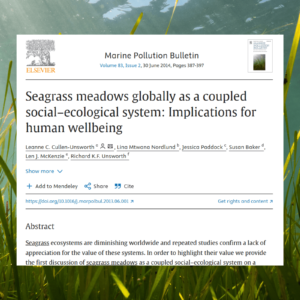
A screenshot of the research paper "Seagrass meadows globally as a coupled social–ecological system: Implications for human wellbeing" overlain on an image of seagrass in North Wales
new science

Project Seagrass Journal Club: October 2024

We have just launched a journal club for the Project Seagrass team. These monthly meetups work much like a book club, members of the team each suggest a relevant scientific paper, vote on their favourite, then read the winning paper prior to meeting. During the journal club we critically discuss

Read More »
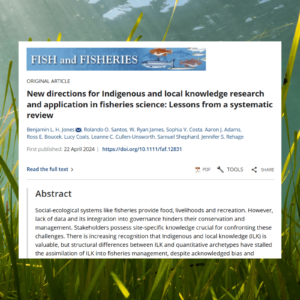
A screenshot of the research paper "New directions for Indigenous and local knowledge research and application in fisheries science: Lessons from a systematic review" overlain on an image of seagrass in North Wales
new science

Indigenous and Local Knowledge in Fisheries Science

Seagrass meadows play a critical role in keeping our oceans healthy and stocked with food, providing valuable nursery habitat to over 1/5th of the world’s largest 25 fisheries. Seagrass meadows are also important to small-scale fisheries, particularly as a place to find and collect a reliable source of food with some

Read More »

Coastal Communities Network Gathering 2024

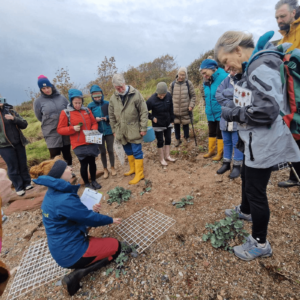
Earlier this month Project Seagrass’ Senior Conservation Officer Katy Waring attended the yearly gathering for coastal communities from the Coastal Communities Network  facilitated by Fauna and Flora International. The event was held on the island of Millport at their field studies centre.   The 3-day event was inspiring; groups from around

Read More »
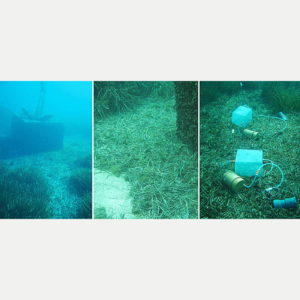
From left to right: View of the STARESO harbor entrance with Posidonia meadow islands and an accumulation of dead leaves. Close-up of litter accumulation. Experimental benthic incubation device ('bell') installed on accumulations of Posidonia dead leaves (10 m deep). Credit: G.Lepoint & W. Champenois / ULiège
new science

Dead leaves in sea break down into a compost that produces oxygen

Researchers from the University of Liège (BE) studied the fate of the material produced by Posidonia seagrass meadows. This study, carried out in the Mediterranean Sea at STARESO, shows that the dead leaves of what is commonly known as Neptune grass accumulate in shallow areas, where they break down like

Read More »