Tag: coastal erosion

Seagrass Fish Fence

The Use of Seagrass in Flood Defences and Reducing Beach Erosion

Ewan Garvey, one of Project Seagrass’ Interns for the 2025-26 academic year, explores how seagrass can provide protection for coastal communities. As the seasons transition from autumn into winter, storms often become a pressing concern for coastal communities. In recent years, the growing impacts of climate change have become increasingly

Read More »
Seagrass Fish Fence

The Use of Seagrass in Flood Defences and Reducing Beach Erosion

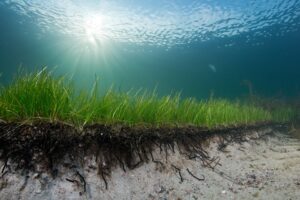
Ewan Garvey, one of Project Seagrass’ Interns for the 2025-26 academic year, explores how seagrass can provide protection for coastal communities. As the seasons transition from autumn into winter, storms often become a pressing concern for coastal communities. In recent years, the growing impacts of climate change have become increasingly clear: extreme weather events once considered “once-in-a-decade” now seem to strike far more frequently. In response, governments and communities are looking for protective solutions, investing heavily in sea defence systems, ranging from sandbags to seawalls. But what if nature has already developed a solution? Enter seagrass. Seagrass’s unique characteristics make it a powerful ally in protecting coastlines. Unlike concrete walls or other flood defence systems, seagrass meadows work with natural processes to reduce erosion and flooding, while also creating vital habitat for marine life. How Seagrass Protects Our Shores Root FixationMuch like how trees stabilise the soil in forests, seagrass root systems anchor sand and mud in place, reducing sediments from being washed away during storms. This helps to maintain the structure of beaches, providing more stable coastal habitats. Dissipation of Wave EnergyWhen waves pass over seagrass meadows, the blades create friction. This slows the water, disperses energy, and reduces the force that reaches the shoreline. This means water travels up the beach less and can lessen flooding events. Challenges Hard-engineered coastal defences such as rock armour can cost upwards of £1 million for just a 35-metre section. Seagrass restoration is also expensive, and to date has been largely funded through philanthropic and government funding mechanisms. Seagrass restoration is not without challenges; newly planted seeds are vulnerable to being washed away or buried by shifting sediment before they can properly establish. Seagrass also requires good water quality; too much pollution can prevent seedlings from developing. In many areas, improving river and coastal water quality must go hand in hand with restoration for projects to succeed. A Blended Solution Is seagrass the silver bullet for coastal protection? Not entirely. By blending natural and engineered approaches, we can create more sustainable, resilient coastlines—ones that not only protect us from storms but also support thriving marine ecosystems. Combining engineered solutions such as breakwaters or seawalls with seagrass meadows could reduce wave energy and sediment loss, which would lower the stress on the artificial defences. This could result in cheaper, smaller sea defence structures, reducing both environmental impact and cost. References and Extra Research “Seagrass as a nature-based solution for coastal protection” by Forrester, Leonardi, Cooper & Kumar (2024) Infantes et al. (2022) — Seagrass roots strongly reduce cliff erosion rates in sandy sediments Donatelli et al. (2018) — “Seagrass Impact on Sediment Exchange Between Tidal Flats and Salt Marsh, and The Sediment Budget of Shallow Bays” Bricheno, L. M., et al. “Climate change impacts on storms and waves relevant to the UK and Ireland.” MCCIP Science Review 2025 (2025).


Read More »

Seagrass crucial to stemming the tide of coastal erosion

The sea devours large tracts of land when storms wash sand out to sea from the coast. A new study involving a researcher from the University of Gothenburg has shown that seagrass can reduce cliff erosion by up to 70% thanks to its root mats binding the sand. Coastal erosion is a global problem that is often combated by replenishing the coast and beaches with new sand in locations where storms wreak the greatest havoc. According to a 2016 survey conducted by the Geological Survey of Sweden, 12% of Skåne’s coastline in southern Sweden is vulnerable to increasing rates of coastal erosion. It is an even bigger issue in other countries. In the Netherlands, the coastline is protected through the construction of dikes made from stone and mud. Another solution is to utilize nature’s own defenses against coastal erosion. In this new study, researchers examined the importance of seagrass for preserving the coastline. “We have seen that seagrass meadows in the coast are valuable assets in mitigating erosion. We already know that their long canopies serve as breakwaters, but now we can show that their root mats also bind together the underwater sand dunes, effectively reinforcing them,” says Eduardo Infantes, a marine biologist at the University of Gothenburg and the lead author of the study which has been published in the journal Marine Ecology Progress Series. More powerful storms in the future Common eelgrass is a seagrass species that grows along Sweden’s coasts, and there are areas with large seagrass meadows growing on the bottom sediments, such as in Skåne. In other places, the seagrass has disappeared altogether. This not only represents an ecological loss, it can also mean that the coast becomes more vulnerable to erosion. As the climate changes, storms risk becoming more powerful, which in turn can lead to an increase in coastal erosion. Approximately 8% of the world’s population live in areas at an elevation of fewer than 10 meters above sea level. Rising sea levels may see many people affected by coastal erosion. “This is why it is even more important to preserve those seagrass meadows that still exist today and to replant seagrass in those places where it has disappeared. In our research, we have made successful attempts to restore common eelgrass meadows on the Swedish west coast, but if such replanting efforts are to succeed, there is a need for detailed studies of the current status seabed environment,” says Eduardo Infantes. In this study, the researchers took samples of sandy sediments with and without common eelgrass from a number of sites and placed them in a large tank capable of simulating waves. The experiments demonstrated that the sand is eroded far less by waves when seagrass is growing in it. The researchers also took samples from muddy seabeds but found that the effect of the seagrass there was less. However, this matters less since muddy seabeds are most commonly found in fjords and other areas that are less exposed to waves. More factors in field tests The next step will be to move out of the laboratory environment and take measurements of sand erosion on an exposed shoreline along the coast. Other factors such as currents, traffic on the water, inflows from rivers etc. can then affect the erosion. “It’s more complicated in the field, but we have created realistic storm waves in our experiments and the seagrass has clearly shown a protective effect against erosion. I think we will be able to demonstrate the similar effects in field tests,” says Eduardo Infantes. More information: E Infantes et al, Seagrass roots strongly reduce cliff erosion rates in sandy sediments, Marine Ecology Progress Series (2022). DOI: 10.3354/meps14196

Read More »