NEWS

NEWS

Keeping you up to date with Project Seagrass news and views with a mixture of field notes and commentary on seagrass and marine conservation topics.

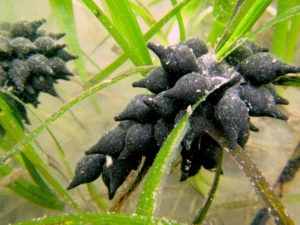
Sea snail

Sea snails – Creatures that call seagrass home

In a new blog series, our Conservation Trainee Abi David explores some of the amazing creatures that call seagrass meadows their home. Sea snails are a hugely diverse group of marine gastropod found in all over the world. There is such a vast range of different colours, sizes, diets and

Read More »
A member of the Project Seagrass team holds a seagrass transplant in a gloved hand.

Introducing the Seagrass Hug

In 2024, the Project Seagrass team introduced the Seagrass Hug to our planting methodology. The method was developed by Anouska Mendzil, Senior Science Officer at Project Seagrass and Swansea University, and aims to determine whether surrounding seeding plots with more established transplants provides protection for emerging seeds in restoration practices.

Read More »
UK Seagrass Symposium Logo

UN endorsed Seagrass Symposium hosted in Welsh capital

The UK Seagrass Symposium 2025 took place in Cardiff last week, bringing together scientists, conservation professionals, practitioners, and community groups from across the UK. Hosted by Project Seagrass, the event was the first in the UK Seagrass Symposium (UKSS) series to receive endorsement as an official Ocean Decade Activity as

Read More »
Two VR headsets are placed on the rocks at the coast at Ogmore in South Wales.

My Seagrass Adventure: New immersive VR experience launched

On the 25th and 26th October, the team from Project Seagrass attended Swansea Science Festival to launch new VR experience: My Seagrass Adventure. The experience has been created as part of an innovative partnership between Project Seagrass, Proper Good Films, and Onyva Studio and takes users on a mesmerising journey

Read More »
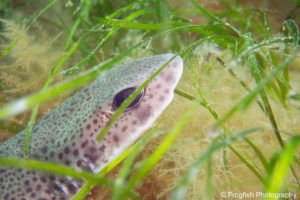
Catshark in seagrass

Spotted catshark – Creatures that call seagrass home

In a new blog series, our Conservation Trainee Abi David explores some of the amazing creatures that call seagrass meadows their home. The small spotted catshark (Scyliorhinus canicula) is a small shark species growing up to 1 meter long and can be seen around European and North African coastlines. They

Read More »

Seagrass to the rescue and rescue to the seagrass

In an article for Halloween, Grace Cutler, one of Project Seagrass’ Interns for the 2025-26 academic year, explores the frightening reality of continued seagrass loss as a result of anthropogenic activity and how this in turn threatens seagrass’ role in supporting people and planet. Werewolves are struck down by silver

Read More »
Zostera marina seagrass meadows with a snakelocks anemone

Snakelocks anemone: Creatures that call seagrass home

In a new blog series, our Conservation Trainee Abi David explores some of the amazing creatures that call seagrass meadows their home. The snakelocks anemone is a funny looking creature commonly found around the UK. They have up to 200 long, wavy tentacles and can grow on average to about

Read More »
Members of Project Seagrass staff are planting seagrass seeds using DIS guns. They are planting into quadrats. It is early morning and the sun hasn't yet risen.

Rethinking Marine Restoration: Why Permits Could Be Holding Us Back

The Ocean is in crisis. Coral reefs are bleaching, seagrass meadows are vanishing, mangroves are being cleared, and biodiversity is plummeting. Scientists estimate we’ve already lost up to 50% of global saltmarshes, 35% of mangroves, and 20% of seagrasses. Yet alongside this sobering decline, momentum for marine restoration has never

Read More »
biodiversity

Starting the Seagrass and Dugong fightback

  The Dugong (Dugong dugon) is IUCN Red listed as Vulnerable, in many of the 46 range states that contain Dugong its status is a lot worse. Historic hunting, loss of its seagrass habitat and the impacts of by-catch have been the primary causes of its decline. Back in 2007 the

Read More »
conference

Registration for the 12th International Seagrass Biology Workshop is Now Open!

The International Seagrass Biology Workshop (ISBW) is the only international meeting specifically tailored to seagrass scientists, professionals and students. Abstract submissions are now open as are proposals for workshops. All payment is via PayPal using credit/debit cards. There is one registration fee. It covers access to all parts of the conference program, including the

Read More »
biodiversity

Learning to protect seagrass in the heart of the Coral triangle.

  Indonesia is at the heart of the Coral Triangle, an area characterised by having the World’s highest marine biodiversity. With over 17000 islands, 51,00km2 of coral reef and at least 30000 km2 of seagrass its marine life is extensive and spectacular. But with a growing population, rapidly expanding GDP,

Read More »
biodiversity

Puttalam Lagoon – Paradise Lost?

At the end of August I spent 10 days conducting fieldwork in Pattalam Lagoon, which is situated in the north west of Sri Lanka. The purpose of my visit to Puttalam Lagoon was to set up socio-economic and fish landings surveys with a research collaborator, who will now complete the

Read More »