NEWS

NEWS

Keeping you up to date with Project Seagrass news and views with a mixture of field notes and commentary on seagrass and marine conservation topics.

PhD student Teigan who is undertaking a PhD exploring the influence of water quality on greenhouse gas emissions. Teigan is seated with a bookshelf behind her. She is wearing a grey jumper and has long dark hair.

Greenhouse gas emissions from seagrass: Q&A with Teigan

In autumn 2024, Teigan joined the teams at Project Seagrass and Swansea University to undertake a PhD exploring the influence of water quality on greenhouse gas emissions from seagrass. Teigan’s PhD forms part of Accelerate Seagrass, a collaborative program with Climate Impact Partners, Deloitte, and the National Oceanography Centre to

Read More »
Three members of Project Seagrass staff are standing along a transect line gathering quadrat data on a beach in the Isle of Wight as part of our May fieldwork

Solent Seagrass Update – A Year in Review

Seagrass Restoration Efforts to restore seagrass marine habitat at our two restoration sites on the Isle of Wight began in March and April this year under the Solent Seascape Project.  A total of 132,000 seeds and 2,160 transplants have been planted across the two sites. There are plans to continue this

Read More »
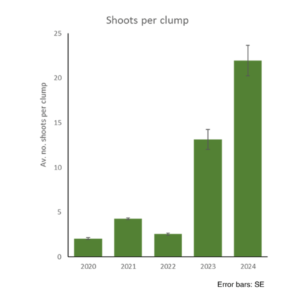
Graph showing shoots per clump from recent monitoring in Dale

Dale Seagrass Update

Following scientific trials in 2019, in 2020 many seagrass seeds were planted in Dale, supported by the community, school children and local organisations. Since planting, the seagrass area has been reseeded several times to infill gaps and support it as it develops. Despite some setbacks, the restoration area is now

Read More »
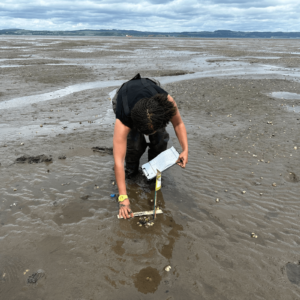
A member of the Restoration Forth is crouched on the beach. They are holding a ruler and a clipboard as they record data as part of the monitoring of seagrass shoots.

Project Update: Restoration Forth December 2024

Restoration Forth aims to restore seagrass meadows and native oysters into the Firth of Forth, to create a healthier coastline for people and nature.   Find out more about the project here.  We’ve reached 30,000 oysters! October was a busy month for the Restoration Forth oyster team. We had an absolutely

Read More »
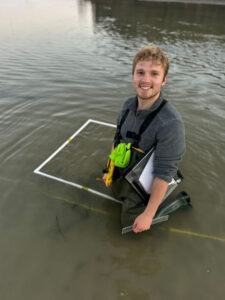
Finn (one of Project Seagrass' 2024-25 interns) is wearing waders and kneeling in the water. He is kneeling next to a quadrat along a transect line. He is holding a ruler and pencil and has a folder with monitoring sheets tucked under his arm.

End of year reflections from our 2024-25 interns

In September 2024, Project Segrass welcomed Finn, Grace, and Heather as our interns for the 2024-25 academic year. Finn and Heather have joined us as interns from the University of St Andrew’s and Grace has joined us from Swansea University. In this interview Finn, Grace, and Heather share their experiences

Read More »
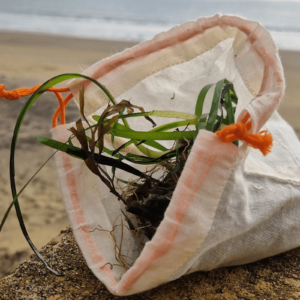
A white cloth bag contains seagrass fragments collected on a fragment walk. The bag is placed on a wall with the sea in the background.

Community-based seagrass restoration: Fragment Walks

In 2024, Project Seagrass launched a new Fragment Walk initiative on the Isle of Wight to support community-based seagrass restoration as part of our work in the Solent. Seagrass Fragments Seagrass meadows are sensitive habitats which can be easily uprooted. As a result of storms or other disturbances, fragments of

Read More »
Seagrass meadow in Florida

Two new studies call for clear frameworks for coastal CO₂ sequestration

Two new studies call for clear framework conditions for CO2 sequestration in coastal areas, including a digital twin for projections and an independent body for certification and new legal structures for monitoring. The two papers led by researchers from Helmholtz-Zentrum Hereon were recently published in Environmental Research Letters and Elementa. So-called “blue carbon ecosystems”

Read More »
A screenshot of the research paper "New directions for Indigenous and local knowledge research and application in fisheries science: Lessons from a systematic review" overlain on an image of seagrass in North Wales
new science

Indigenous and Local Knowledge in Fisheries Science

Seagrass meadows play a critical role in keeping our oceans healthy and stocked with food, providing valuable nursery habitat to over 1/5th of the world’s largest 25 fisheries. Seagrass meadows are also important to small-scale fisheries, particularly as a place to find and collect a reliable source of food with some

Read More »

Coastal Communities Network Gathering 2024

Earlier this month Project Seagrass’ Senior Conservation Officer Katy Waring attended the yearly gathering for coastal communities from the Coastal Communities Network  facilitated by Fauna and Flora International. The event was held on the island of Millport at their field studies centre.   The 3-day event was inspiring; groups from around

Read More »
From left to right: View of the STARESO harbor entrance with Posidonia meadow islands and an accumulation of dead leaves. Close-up of litter accumulation. Experimental benthic incubation device ('bell') installed on accumulations of Posidonia dead leaves (10 m deep). Credit: G.Lepoint & W. Champenois / ULiège
new science

Dead leaves in sea break down into a compost that produces oxygen

Researchers from the University of Liège (BE) studied the fate of the material produced by Posidonia seagrass meadows. This study, carried out in the Mediterranean Sea at STARESO, shows that the dead leaves of what is commonly known as Neptune grass accumulate in shallow areas, where they break down like

Read More »
Seagrass in Orkney

Climate Impact Partners and Deloitte Join Forces to Unlock Large-Scale Seagrass Recovery Financing

Climate Impact Partners and Deloitte, in collaboration with Project Seagrass and the UK’s National Oceanography Centre, announce a groundbreaking program to fund UK seagrass recovery and unlock long-term finance to save and reinstate vital seagrass meadows. The program will fund critical research across UK seagrass meadows, mapping the ecosystems and developing methods to restore them

Read More »
Neil is standing on board Project Seagrass' boat Gwen. He is wearing a hat, sunglasses, and a red coat.
Volunteer

Seagrass Ocean Rescue Volunteer Profile: Neil

The Seagrass Ocean Rescue North Wales programme relies on the commitment and enthusiasm of local volunteers. We spoke to regular volunteer Neil about his experiences of volunteering as part of the programme. Volunteer Interview Tell us a little bit about yourself: I grew up in North Wales, then moved around

Read More »