Category: Blogs

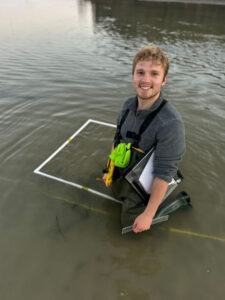
Finn (one of Project Seagrass' 2024-25 interns) is wearing waders and kneeling in the water. He is kneeling next to a quadrat along a transect line. He is holding a ruler and pencil and has a folder with monitoring sheets tucked under his arm.

End of year reflections from our 2024-25 interns

In September 2024, Project Segrass welcomed Finn, Grace, and Heather as our interns for the 2024-25 academic year. Finn and Heather have joined us as interns from the University of St Andrew’s and Grace has joined us from Swansea University. In this interview Finn, Grace, and Heather share their experiences

Read More »
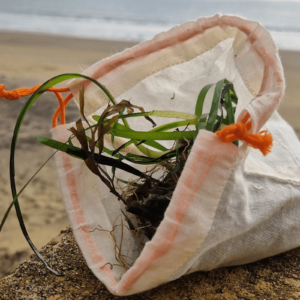
A white cloth bag contains seagrass fragments collected on a fragment walk. The bag is placed on a wall with the sea in the background.

Community-based seagrass restoration: Fragment Walks

In 2024, Project Seagrass launched a new Fragment Walk initiative on the Isle of Wight to support community-based seagrass restoration as part of our work in the Solent. Seagrass Fragments Seagrass meadows are sensitive habitats which can be easily uprooted. As a result of storms or other disturbances, fragments of

Read More »
Seagrass meadow in Florida

Two new studies call for clear frameworks for coastal CO₂ sequestration

Two new studies call for clear framework conditions for CO2 sequestration in coastal areas, including a digital twin for projections and an independent body for certification and new legal structures for monitoring. The two papers led by researchers from Helmholtz-Zentrum Hereon were recently published in Environmental Research Letters and Elementa. So-called “blue carbon ecosystems”

Read More »
Volunteers from Moray Ocean Community and partners at the Inverness Royal Academy Citizen Science day

Interview with Moray Ocean Community

We spoke to Moray Ocean Community about their volunteering in the Moray Firth area and how they integrate the SeagrassSpotter app into their activities. Read the full interview below: Can you tell us about Moray Ocean Community and how it started? Moray Ocean Community started to come together over two

Read More »

Seagrass planting trials underway in Cardiff

Scientists from the marine conservation charity Project Seagrass are undertaking seagrass planting experiments along the South & West Wales coastline, including a new planting site in Butetown along Cardiff’s Foreshore.  Cardiff’s Foreshore is a popular place for sea-angling for species such as cod, which uses seagrass meadows as a nursery

Read More »
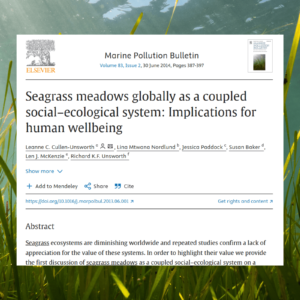
A screenshot of the research paper "Seagrass meadows globally as a coupled social–ecological system: Implications for human wellbeing" overlain on an image of seagrass in North Wales

Project Seagrass Journal Club: October 2024

We have just launched a journal club for the Project Seagrass team. These monthly meetups work much like a book club, members of the team each suggest a relevant scientific paper, vote on their favourite, then read the winning paper prior to meeting. During the journal club we critically discuss

Read More »
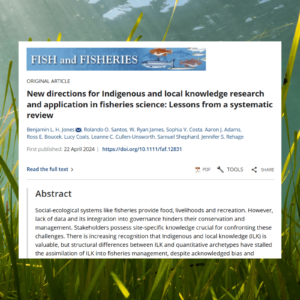
A screenshot of the research paper "New directions for Indigenous and local knowledge research and application in fisheries science: Lessons from a systematic review" overlain on an image of seagrass in North Wales

Indigenous and Local Knowledge in Fisheries Science

Seagrass meadows play a critical role in keeping our oceans healthy and stocked with food, providing valuable nursery habitat to over 1/5th of the world’s largest 25 fisheries. Seagrass meadows are also important to small-scale fisheries, particularly as a place to find and collect a reliable source of food with some

Read More »

Coastal Communities Network Gathering 2024

Earlier this month Project Seagrass’ Senior Conservation Officer Katy Waring attended the yearly gathering for coastal communities from the Coastal Communities Network  facilitated by Fauna and Flora International. The event was held on the island of Millport at their field studies centre.   The 3-day event was inspiring; groups from around

Read More »
Finn (one of Project Seagrass' 2024-25 interns) is wearing waders and kneeling in the water. He is kneeling next to a quadrat along a transect line. He is holding a ruler and pencil and has a folder with monitoring sheets tucked under his arm.

End of year reflections from our 2024-25 interns

In September 2024, Project Segrass welcomed Finn, Grace, and Heather as our interns for the 2024-25 academic year. Finn and Heather have joined us as interns from the University of St Andrew’s and Grace has joined us from Swansea University. In this interview Finn, Grace, and Heather share their experiences and highlights from their first three months as interns with Project Seagrass. What have you been up to during the first three months as interns with Project Seagrass?  Heather: My time at Project Seagrass has been spent on a really diverse set of tasks so far, ranging from practical fieldwork out in North Wales, to desk jobs back at HQ analysing data or building equipment. One of my favourite jobs so far has been processing the seeds harvested in the summer. This task was based in the warehouse at HQ and involved separating the seeds from their protective seagrass sheaths using a water-tower. Apart from being a very satisfying job, doing this also allowed me to spend time looking at the infauna living among the vegetation and also to see, first-hand, the huge natural variation present in the seeds we are working with. In the end, we helped process over 1,000,000 seeds like this in the space of one month.  Grace: Since starting I have assisted various projects within Project Seagrass, getting to know the team and building my knowledge base. Some of the major parts were aiding Isle of Wight and West Wales monitoring and mapping fieldworks, and processing seagrass seeds at HQ, as well as breaking down fieldwork data to analyse the results. In this short time I feel I have developed my confidence in field data collection and analysis, and am beginning to understand the precarious status of seagrass meadows in the UK.  Finn: I have done so many different things since starting my internship with Project Seagrass – helping out with seed processing, building fieldwork equipment, visiting the nursery to help with monitoring the seagrass growing there, taking part in engagement events, and completing a review of the seagrass microbiome as well as various other tasks at HQ. A big part of my internship has also been going on fieldwork to the Isle of Wight every month to monitor restoration plots of seeds and transplants planted in the spring.   What have been your highlights so far?  Heather: My highlight so far was the sunny afternoon I spent surveying the seabed of the Cymyryn Strait by kayak. We found a really dense, healthy seagrass meadow there with all three British seagrass species present – it was also the first time I had ever seen Ruppia!  Grace: My standout experience at the moment has to have been going on fieldwork in South and West Wales. Participating in mapping new sites for potential seagrass restoration is very satisfying, especially when I can plot out our GPS tracks on a map afterwards, and have a nice little record of where we’ve been. I’ve also enjoyed developing my programming knowledge with real data to make useful and interpretable figures.  Finn: My highlight so far has definitely been going out on fieldwork and seeing my first seagrass meadow in the UK!! It was awesome to see the work Project Seagrass has done paying off and being able to see seagrass seedlings and transplants still surviving and growing. As well as the seagrass itself, I have seen some cool animals living within the seagrass. It can be a muddy, wet, and cold job but despite that fieldwork is still my favourite part of my internship.  What are you looking forward to in 2025?  Heather: At the moment, I am working towards setting up a controlled tank here, in HQ, in anticipation of the New Year when I will be beginning my undergraduate project. For this, I will be looking at the seeds we have processed in more detail, aiming to quantify their natural physical variation as well as determine if there are any links between this and the seeds’ ability to produce successful young plants. At the moment, this subject is not well resolved in the literature and so it will be great to push this knowledge boundary, even a little, and have the chance to continue working with the seeds I have already put so much energy into caring for.  Grace: Moving into 2025, I’m looking forward to starting and linking together some smaller projects surrounding site characteristics. These include combining the physical parameters measured in different fieldworks at each site with background information to assess their suitability for seagrass restoration. As part of this, I’m excited to spend some time in the lab analysing site sediment samples and may also investigate programming models for site assessment.  Finn: I’m looking forward to more fieldwork and taking part in the planting of seagrass seeds in the spring. Alongside the usual fieldwork, I am also going to be collecting data for my undergraduate project investigating the physical and biological factors that determine the distribution of seagrass on a fine and site-specific scale on the Isle of Wight. This data will help inform future decision making about selecting the best sites for seagrass restoration to hopefully increase the success of restoration. I have already collected some data, carrying out biotope mapping to characterise the habitats and species present alongside seagrass meadows and restoration sites.   Each year Project Seagrass welcome a group on interns to develop their skills. These opportunities are available for students studying a university course that requires a year in industry as part of their studies and are advertised on our website. Keep an eye on our social media channels for announcements of future opportunities.

Read More »
A white cloth bag contains seagrass fragments collected on a fragment walk. The bag is placed on a wall with the sea in the background.

Community-based seagrass restoration: Fragment Walks

In 2024, Project Seagrass launched a new Fragment Walk initiative on the Isle of Wight to support community-based seagrass restoration as part of our work in the Solent. Seagrass Fragments Seagrass meadows are sensitive habitats which can be easily uprooted. As a result of storms or other disturbances, fragments of seagrass (individual seagrass plants with the rhizome or reproductive root and node system still intact) can become dislodged, uprooted, and washed up onto beaches. However, there is still an opportunity, for these plants to thrive by replanting the dislodged fragments. This presents a unique opportunity to involve the local community in seagrass planting at our Isle of Wight restoration sites. Seagrass meadows are critical and beautiful marine habitats that are essential for people and our planet. By undertaking active seagrass restoration on the Isle of Wight we can ensure that threatened and diminishing seagrass species can thrive, and additional fragment planting alongside our restoration efforts through advocacy and local community involvement presents an additional opportunity and involvement for all and reconnection to the seascape. Anouska Mendzil Project Seagrass Fragment Walks In spring 2024, we delivered a Fragment Walk pilot project where members of the public joined us to collect seagrass fragments at Priory Bay. This enabled us to gauge the level of interest for volunteer opportunities of this nature amongst the local Isle of Wight community. We were pleased to see positive uptake and interest in the initiative and went on to expand the project to include the following: A fragment collection point at St Helens A fragment walk to collect seagrass fragments A fragment preparation workshop Fragment planting at our restoration sites Monitoring our planted seagrass During the fragment preparation workshop, volunteers attach fragments to a pin using natural twine. This provides an anchor point for when the fragments are replanted, increasing the chances of re-establishment. During 2024 we have undertaken a total of 6 fragment walks, with 214 volunteers attending. We have also started to plant fragments in our restoration area at Priory Bay, Isle of Wight, with a total number of 329 fragments planted. Our fragment collection point is located at St Helens Duver (What3Words: invest.cropping.scatter). Fragment Collection Points In addition to our direct engagement through the Fragment Walks we have additionally installed two Fragment Collection Points in Sandown and St Helen’s. These collection points enable members of the public to collect and place seagrass fragments found on the beach into the fragment collection points, which can then be retrieved and replanted in local seagrass meadows and restoration sites. Project Seagrass in the Solent Project Seagrass is working to restore 3 hectares of seagrass on the Isle of Wight as part of the Solent Seascape Project alongside undertaking planting trials as part of the Seagrass Ocean Rescue: Solent programme. Fragment Walks enable us to engage with members of the local community and trial another approach to seagrass restoration on the Island. If you would like to set up and run your own fragment walks around the Solent or further afield we will be releasing this as a marine practitioner protocol in 2025. Keep an eye on our social media for the dates of future Fragment Walks or contact volunteers@projectseagrass.org to be kept informed about future opportunities.

Read More »
Seagrass meadow in Florida

Two new studies call for clear frameworks for coastal CO₂ sequestration

Two new studies call for clear framework conditions for CO2 sequestration in coastal areas, including a digital twin for projections and an independent body for certification and new legal structures for monitoring. The two papers led by researchers from Helmholtz-Zentrum Hereon were recently published in Environmental Research Letters and Elementa. So-called “blue carbon ecosystems” for CO2 storage on the coasts and in the ocean can be seagrasses, mangroves or salt marshes, for example. Whether they help to achieve the climate targets and how this can be achieved still needs to be researched in more detail. Projects for CO2 storage are increasingly being initiated by science and industry. But the risks need to be better researched and regulated, say the authors. International legislation is needed for this. Only then could a blue carbon industry be established. Seagrass, pictured here in Florida, could be an option for CO2 storage. Credit: Hereon/Bryce van Dam Clear rules for an industry with a future Regulation through legislation and evaluation are important, says lead author Bryce von Dam from the Hereon Institute of Carbon Cycles. However, this can only be achieved with an international, overarching organization for monitoring, reporting and verification. This organization could issue certificates and create fair conditions. The Paris Climate Agreement is intended to help regulate carbon removal. But until it is fully ratified, there must be other verification bodies. Furthermore, smaller projects should not be disadvantaged—as long as they demonstrably remove greenhouse gases from the atmosphere, say the authors. “In addition, a digital twin that models baseline scenarios and shows what the carbon cycle would look like without blue carbon activities can help. This works well if it collects real data in real time,” says von Dam. The twin should create AI-supported “what-if scenarios” regarding the effectiveness of storage methods. Stronger links between business and science Hereon Institute Director Helmuth Thomas and other researchers have come to the conclusion that the role of coastal and marine ecosystems can contribute to combating climate change. “But only if we find new international governance and legal frameworks.” This is also important in order to recognize unexpected side effects. Only with a clear legal definition could science, business and politics jointly create frameworks. One example would be to clarify liability issues. “Some measures in the wrong place can even lead to an increase in CO2 emissions,” says Thomas. The effectiveness of individual projects needs to be much better researched and evaluated. It is also unclear, for example, to what extent international law already obliges states to restore marine habitats. Binding political guidelines are needed. More information: Bryce Van Dam et al, Towards a fair, reliable, and practical verification framework for Blue Carbon-based CDR, Environmental Research Letters (2024). DOI: 10.1088/1748-9326/ad5fa3  Martin Johnson et al, Can coastal and marine carbon dioxide removal help to close the emissions gap? Scientific, legal, economic, and governance considerations, Elem Sci Anth (2024). DOI: 10.1525/elementa.2023.00071 This article is republished from PHYS.ORG and provided by the Helmholtz Association of German Research Centres. Explore our blog for insights on the latest research from across the globe. Click here

Read More »

Bacterial communities on seagrass leaves shown to suppress waterborne pathogens

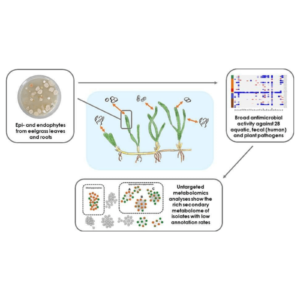
Seagrasses are special: they are the only flowering plants that have returned to sea from land. They are also known as the “lungs of the oceans” because of their ability to photosynthesize. And with the exception of Antarctica, they can be found on all continents, where they form extensive underwater meadows that generate and sustain healthy coastal regions. Seagrass meadows are key ecosystem engineers that directly benefit humans and animals. Hence, they are of enormous ecological and economic importance. They are spawning grounds for economically important fish, hiding places for juvenile fish and habitats for mussels, snails and crabs, making them one of the most productive and diverse ecosystems on earth, along with coral reefs and rainforests. They protect our coasts by stabilizing the sediment. They also store carbon dioxide very quickly and effectively. Graphical abstract. Credit: Science of The Total Environment (2023). Seagrass meadows as natural water purifiers A few years ago, another remarkable ecosystem service of seagrasses was discovered: seagrass meadows reduce the load of pathogenic bacteria in the water around them. A 2017 study showed that the relative abundance of harmful bacteria, including human fecal bacteria and pathogens dangerous to marine animals and humans, was significantly (50%) lower in Indonesian seagrass meadows than in the water outside the meadows. Subsequent studies, including one at GEOMAR, have confirmed the reduction of pathogens such as Escherichia coli, enterococci, Salmonella and Vibrio species in the vicinity of seagrass beds. Scientists of the Research Unit Marine Natural Product Chemistry at the GEOMAR Helmholtz Centre for Ocean Research Kiel have been investigating multiple mechanisms behind this sanitation effect for several years. The results of the first part of their study have recently been published in the journal Science of the Total Environment. How do seagrasses combat pathogens? “The elimination of pathogens from the water is a very complex phenomenon involving physical, (micro)biological and chemical mechanisms” says Dr. Deniz Tasdemir, professor of marine natural product chemistry and senior author of the study. The researchers started first analyzing the cultivable microbiome of Zostera marina, a common seagrass species in the Baltic Sea, and the natural molecules they produce. To do this, they isolated almost 90 bacteria and fungi from the surface and internal tissues of the seagrass leaves (and roots) and tested their extracts for antibiotic activity. These tests were carried out against a large group of aquatic, human and plant pathogens, including Vibrio species, which can cause serious diseases and even death when transmitted to humans by raw or undercooked seafood, or through skin damage during recreational activities. This study showed that the bacteria from healthy leaf surfaces have strong, broad-spectrum antibiotic activity, in some cases even outperforming commercial antibiotics. “This confirmed our hypothesis,” says Prof. Tasdemir. In addition to a few known antimicrobial compounds, the team also discovered the presence of many new ones in these bacteria. These new molecules will now be isolated, in other words chemically purified, their chemical structures will be identified and their potential as future marine antibiotics will be assessed. “This is only the tip of the iceberg for us. We now heavily work, with an international team, on other chemical and microbiome-related mechanisms and how they may contribute to the hygiene effect of seagrasses in the laboratory and in the ocean settings,” says Prof. Tasdemir. Antibiotics from the sea: The potential of the seagrass microbiome The climate change-related ocean warming is increasing the load of pathogens, such as Vibrio species, in coastal waters during summer months. This is also a great public health concern for the German Baltic Sea, as death is being reported among holiday makers. Therefore, the protection and restoration of seagrass meadows is essential for the health of oceans and humans more than ever. On the other hand, the seagrass microbiome holds great potential for the discovery of new antibiotics for other human infections, which is of enormous importance in the fight against rising antibiotic resistance. More information: Deniz Tasdemir et al, Epiphytic and endophytic microbiome of the seagrass Zostera marina: Do they contribute to pathogen reduction in seawater?, Science of The Total Environment (2023). DOI: 10.1016/j.scitotenv.2023.168422 This article is republished from PHYS.ORG and provided by the Helmholtz Association of German Research Centres. Explore our blog for insights on the latest research from across the globe. Click here

Read More »
Volunteers from Moray Ocean Community and partners at the Inverness Royal Academy Citizen Science day

Interview with Moray Ocean Community

We spoke to Moray Ocean Community about their volunteering in the Moray Firth area and how they integrate the SeagrassSpotter app into their activities. Read the full interview below: Can you tell us about Moray Ocean Community and how it started? Moray Ocean Community started to come together over two years ago when founding members were either looking for snorkelling buddies, interested in seagrass, or had read the NatureScot Community-led Marine Biodiversity Monitoring Handbook and wanted to join their local coastal community group but there wasn’t one in the Moray Firth area!  Through some wonderful connections we got together and formed Moray Ocean Community. For our first year we were an informal volunteer group heading out to do snorkels, swims, and citizen science surveys. When we realised how many folk wanted to learn more about the coastline around the Moray Firth and that there was funding available we officially became a Community Interest Company in February 2024. Can you tell us about your volunteering and the groups and organisations you work with? We have completed surveys for a variety of citizen science projects including Seasearch, Project Seagrass’ SeagrassSpotter, Beachwatch, Big Seaweed Search, and Shorewatch. We are also the community collaborator for the Mossy Earth led restoration project Cromarty Seascape focusing on native oyster and seagrass restoration in the firths surrounding the Black Isle, and work closely with the Findhorn, Nairn and Lossie Rivers Trust on seagrass surveys in Findhorn Bay, as part of their Findhorn Watershed Initiative.  All our seagrass survey data has been uploaded on to the NatureScot data platform as well as onto SeagrassSpotter.  And of course we have fun! We get together for social events to enjoy being next to, on, or under the sea through swims and recreational snorkels and paddleboarding. We find SeagrassSpotter a really easy way to introduce seagrass and citizen science to volunteers and we have been learning a lot about it ourselves! It was fantastic to hear from the Project Seagrass experts at the training day in Findhorn earlier this year which covered the app and building on some other survey techniques including quadrats and transects. We have even used it beneath the water when we have been out with the local Burghead Sub-Aqua Club and from paddleboards! What are some of the challenges you face in your activities? As we are all volunteers it is sometimes a juggling act to get all the organising done like funding applications and we are currently working with Fauna and Flora to help us increase our capacity as an organisation which has involved strategy meetings and paperwork but we know it is all so important and worth it so we can get as many people out there learning and protecting the coast as possible. Can you share a success story or a milestone you are particularly proud of? We all really enjoyed supporting a citizen science taster day for students of the Inverness Royal Academy where we worked with partners to introduce three citizen science projects. One was with Whale and Dolphin Conservation to run Shorewatch whale and dolphin surveys (sadly all the dolphins turned up after the school bus left!). One was with ourselves Moray Ocean Community showing students how to use SeagrassSpotter on their phone and try some quadrat measuring. And the final one was with the Marine Conservation Society doing a beach litter survey. The students were fantastic and all our volunteers had a brilliant time and we would love to do more school engagement as we grow and get more folk learning and excited about seagrass! What activities have you got coming up and how can people get involved? We are always up for welcoming new volunteers to our Rising Tides whatsapp group – please do look out for us on social media (links below) and drop us a message to be added. We share swims, snorkels, surveys, and other information there while we work to get some funding to set ourselves up with a website and mailing list. We would like to say a huge thank you to Project Seagrass for all the support as we grow as a new organisation, from information and training to opportunities like sharing our story on your blog. We hope to see some visitors back to the Moray Firth soon! You can catch up with Moray Ocean Community‘s interview on the BBC Radio Scotland Out of Doors programmeand follow Moray Ocean Community on social media to find out more about their work and how to get involved: Facebook X-twitter Instagram

Read More »

Seagrass planting trials underway in Cardiff

Scientists from the marine conservation charity Project Seagrass are undertaking seagrass planting experiments along the South & West Wales coastline, including a new planting site in Butetown along Cardiff’s Foreshore.  Cardiff’s Foreshore is a popular place for sea-angling for species such as cod, which uses seagrass meadows as a nursery area. The Butetown site was identified as a potential location for seagrass restoration efforts based on the presence of small and isolated patches of existing seagrass growing naturally in the area. The scientists are using the experimental trials to explore the possibility of expanding these patches of seagrass for the benefit of biodiversity.  Ben Jones, Chief Conservation Officer at Project Seagrass said, ‘We’ve known about these small patches of seagrass on the foreshore for some time, clinging on, in what looks and feels like quite an extreme site. There’s now huge potential to expand this and create a large and vibrant biodiverse space in this urban coastal environment.‘  Following site assessments and monitoring of the current seagrass patches over the last couple of years, Project Seagrass began small-scale seagrass planting trials earlier this year.  60,000 seagrass seeds, collected from a much larger seagrass meadow in Porthdinllaen in North Wales, were planted out on the foreshore in May, alongside 75 seagrass plants transplanted from a donor meadow in Llanelli.  Emma Fox, South & West Wales Project Lead at Project Seagrass said, ‘The foreshore may not look like your typical site for a seagrass meadow, but exploring restoration within the shadow of Cardiff’s industrial past is an exciting, if challenging, opportunity to learn more about this versatile plant.”  The scientists at Project Seagrass used experimental methods that have shown success in other parts of Wales, but unfortunately, initial monitoring has shown that the seeds and transplants planted in May mostly failed. A further 75 seagrass plants planted out in Llanelli at the same time were still present so the team will now use these failings as a learning exercise to devise new methods for use in the foreshore’s challenging environment.   The planting on the Foreshore forms part of a wider programme of work to investigate sites along the South & West Wales coastline to identify and trial suitable restoration areas. The programme of work is delivered by Project Seagrass in partnership with Swansea University and with funding from Heritage Fund in partnership with Welsh Government; Wasserman Live; Rebel Restoration; and Ozone.  To register interest for future volunteering opportunities as part of this programme please contact: volunteers@projectseagrass.org  

Read More »
A screenshot of the research paper "Seagrass meadows globally as a coupled social–ecological system: Implications for human wellbeing" overlain on an image of seagrass in North Wales

Project Seagrass Journal Club: October 2024

We have just launched a journal club for the Project Seagrass team. These monthly meetups work much like a book club, members of the team each suggest a relevant scientific paper, vote on their favourite, then read the winning paper prior to meeting. During the journal club we critically discuss the paper and analyse how it relates to our own research. Seagrass science is continually evolving, with researchers across the globe constantly pushing the boundaries of our understanding of how these dynamic ecosystems function and work.  This journal club helps us keep abreast of new research, and as it’s held online keeps our team connected across our UK sites. We launched this month with a paper integral to the core values of Project Seagrass: research, community and action. Seagrass meadows globally as a coupled social–ecological system: Implications for human wellbeing, published in 2013 by our CEO, Dr Leanne Cullen-Unsworth and our Chief Scientific Officer, Dr Richard Unsworth, among others. Using this paper to launch Journal club allowed the team to focus on factors influencing the development of Project Seagrass, and to reflect on how our current work aligns with these. The paper describes 7 globally spread case studies highlighting the intricate and dynamic relationship between seagrass and humans, to demonstrate the importance of a social-ecological approach in the field. One reoccurring finding highlights the role of seagrass as a foundation marine species, and nursery ground as vital to subsistence fisheries (fishing for direct community nutrition). Practices such as gleaning (small scale collection of invertebrates from the intertidal using simple gear), and artisanal fin fishing were found key in providing food security and wellbeing for coastal communities, with the highlighted case studies evidencing seagrass decline. The human dependence on seagrass highlights the importance in understanding the associated decline in communities’ capacities for resilience when facing environmental changes. By viewing seagrass meadows as a coupled social-ecological system, projects can carve pathways supporting resilience for both seagrass and people, which in turn support each other. Discussions focussed on a ‘knock before you enter’ approach, and the importance of carrying out stakeholder mapping and social science research to understand complex linkages. This knowledge coupled with ecological site assessments allows conservation and restoration efforts to align with local needs, ensuring social and ecological resilience into the future for seagrass projects. You can access the paper at this link to explore the findings in more depth. Our next journal club meets on the 5th of November, we look forward to sharing the paper and our thoughts on it then. Explore our blog for insights on the latest research from across the globe. Click here

Read More »
A screenshot of the research paper "New directions for Indigenous and local knowledge research and application in fisheries science: Lessons from a systematic review" overlain on an image of seagrass in North Wales

Indigenous and Local Knowledge in Fisheries Science

Seagrass meadows play a critical role in keeping our oceans healthy and stocked with food, providing valuable nursery habitat to over 1/5th of the world’s largest 25 fisheries. Seagrass meadows are also important to small-scale fisheries, particularly as a place to find and collect a reliable source of food with some countries (e.g., Indonesia) seeing up to 60% of coastal populations dependant on seagrass for access to food.  However, fisheries are more than just sources of food—they are also lifelines for millions of people worldwide, underpinning livelihoods, culture, and well-being. Yet despite their important role, managing these resources, especially in the face of climate change and overfishing, is becoming harder due to a lack of solid data.    This is where Indigenous and Local Knowledge (ILK) could support Fisheries Science.  A recent study undertaken by Project Seagrass systematically reviewed 397 fisheries-related research articles and revealed that Indigenous and local communities hold key insights into the ecosystems they live in. Indigenous and local communities have often been fishing in their local areas for generations and possess detailed knowledge about species behaviour, habitats, and environmental changes which could fill significant gaps in formal scientific research.  The Problem: Gaps Between Indigenous and Local Knowledge and Scientific KnowledgeWhile the scientific community acknowledges the importance of ILK, a large challenge remains: ILK is largely qualitative, based on observations and traditions, whereas fisheries management is based on quantitative data—numbers, charts, and models.   Despite efforts to utilise information from scientific knowledge and ILK, the integration has been slow with many studies still viewing ILK as something that needs to be validated through scientific data.   The Solution: A New Approach to Fisheries Research The research highlights the need for more collaborative methods to enhance Fisheries Management by integrating ILK and scientific knowledge.  Rather than simply comparing Indigenous and Local Knowledge to scientific data, we should view these knowledge systems as complementary. ILK can inform fish population trends, help establish marine protected areas, and guide sustainable fishing practices with a greater chance of success.   What’s Next? Moving Towards Integrated Fisheries Management It is crucial to respect both Indigenous and Local Knowledge and scientific knowledge as equally valid.   By intertwining these knowledge systems, we can build a more holistic and effective approach to fisheries management, ensuring that the voices of Indigenous and local communities are heard and their knowledge utilized.  The next wave of fisheries science should aim to bridge the gap between data-driven science and the rich, qualitative insights from those who know the waters best. The future of sustainable fisheries management depends on it.  More information: Jones et al, New directions for Indigenous and local knowledge research and application in fisheries science: Lessons from a systematic review. Fish and Fisheries (2024) DOI: https://doi.org/10.1111/faf.12831   Explore our blog for insights on the latest research from across the globe. Click here

Read More »

Coastal Communities Network Gathering 2024

Earlier this month Project Seagrass’ Senior Conservation Officer Katy Waring attended the yearly gathering for coastal communities from the Coastal Communities Network  facilitated by Fauna and Flora International. The event was held on the island of Millport at their field studies centre.   The 3-day event was inspiring; groups from around Scotland showcased their projects, held skill-sharing workshops, and collectively unpacked common challenges such as funding, advocacy, and management to explore collaborative solutions.   Project Seagrass Trustee Rosslyn Barr was also in attendance with her project Edinburgh Shoreline. Rosslyn shared Edinburgh Shoreline’s story, including their part in Restoration Forth  and news of an exciting new project they are developing looking at blue mussels.     Many of the seagrass groups were in attendance, providing an opportunity to catch up and explore opportunities for collaboration in 2025.  As part of the gathering, Katy delivered a pilot of a new survey developed as part of “Accelerate Seagrass” a new collaborative programme with Climate Impact Partners, Deloitte, and the National Oceanography Centre. The survey aims to connect with local ecological knowledge around Scotland on both current and historical seagrass and to understand localised drivers of decline. This data will help identify areas for tailored conservation and restoration work from a social-ecological perspective ensuring resilience of projects.      Katy gathered valuable feedback from members of COAST, CROMACH, Eigg Environmental Action Group, and CLP nature action which will be used to inform further development of the survey.  Thanks to these projects for their feedback, we are looking forward to sharing the final piece with you soon.   The breadth of positive action delivered by these mostly voluntary ran community groups was inspiring and highlights the power of community. Thanks to the team at Fauna and Flora International for inviting us and the work they do supporting these groups to flourish.  Find out more about the organisations in attendance:  Community of Arran Seabed Trust (COAST)  Young Sea Changers Scotland  Carna Conservation Initiative   Clean Coast Outer Hebrides  Dunoon Development Trust  Kintyre Coastal Network  Fair Isle Marine Research Organisation (FIMRO)  CLP Nature Action  Eriboll Community  Craignish Restoration of Marine and Coastal Habitats (CROMACH)  Eigg Environmental Action Group  Moray Ocean Community  East Have Together  Edinburgh Shoreline  Friends of Sound of Jura  Fairlie Coastal  Community Association of Lochs and Sounds (CAOLAS)  Argyll Hope Spot  The Scottish Coastal Clean Up  Skye Seas Survey Initiative  Friends of Loch Hourn   

Read More »
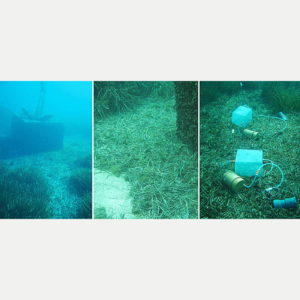
From left to right: View of the STARESO harbor entrance with Posidonia meadow islands and an accumulation of dead leaves. Close-up of litter accumulation. Experimental benthic incubation device ('bell') installed on accumulations of Posidonia dead leaves (10 m deep). Credit: G.Lepoint & W. Champenois / ULiège

Dead leaves in sea break down into a compost that produces oxygen

Researchers from the University of Liège (BE) studied the fate of the material produced by Posidonia seagrass meadows. This study, carried out in the Mediterranean Sea at STARESO, shows that the dead leaves of what is commonly known as Neptune grass accumulate in shallow areas, where they break down like a compost, remineralizing the organic matter. This has a previously underestimated effect on carbon fluxes in the Mediterranean coastal environments. Surprisingly, alongside this CO2 emission, oxygen production was also measured. This is linked to the presence of photosynthetic organisms living in this compost in the sea, which fundamentally differentiates it from compost on land. The work is published in the journal Estuarine, Coastal and Shelf Science. From left to right: View of the STARESO harbor entrance with Posidonia meadow islands and an accumulation of dead leaves. Close-up of litter accumulation. Experimental benthic incubation device (‘bell’) installed on accumulations of Posidonia dead leaves (10 m deep). Credit: G.Lepoint & W. Champenois / ULiège Posidonia, a flowering plant emblematic of the Mediterranean Sea, commonly known as Neptune grass, forms vast meadows (underwater prairies) in shallow waters (less than 40m deep). “It is a terrestrial plant that recolonized the marine environment several million years ago, a small quirk of evolution,” explains Alberto Borges, an oceanographer at ULiège. “Like most terrestrial plants in our regions, Posidonia loses its oldest leaves in autumn. These dead leaves accumulate as litter (like at the base of trees) in large patches near the seagrass meadows.” It is these accumulations of dead leaves and their breakdown and transformation that interested the researchers who traveled to STARESO, an underwater and oceanographic research station located in Calvi, Corsica, to conduct a study on the primary production and degradation of organic matter in Posidonia litter. “In the litter, the organic matter breaks down and releases nutrients and CO2, like compost in gardens,” explains Gilles Lepoint. “The litter accumulates in open, sun-light areas.” “Every gardener knows that to grow plants, you need nutrients and light. It is on this basis that we conducted our study which led to a surprising first result: in the litter resulting from the accumulation of material that one would initially imagine as dead and inert, we measured oxygen production, a consequence of the photosynthetic activity of macroalgae drifted from rocks, living Posidonia shoots detached from the nearby meadow, and diatoms (microscopic algae) present in the litter.” To summarize, in this nutrient-rich environment, all living plants associated with the litter thrive and photosynthesize. This oxygen production is significant but does not offset the oxygen consumption by the decomposition of the dead leaves. These accumulations, therefore, remain net consumers of oxygen and, consequently, net emitters of CO2, much like compost and litter in terrestrial environments. The second result from this study somewhat surprised the researchers. “While we thought that Posidonia litter degraded relatively quickly, this study showed us the opposite, based on measurements of litter mass loss—it degrades more slowly,” says Alberto Borges. “We measured respiration through short-term (1-day) incubations based on very precise oxygen measurements.” These measurements provided a more realistic and accurate estimate, with lower values than those traditionally obtained by monitoring mass loss over very long periods (several months). This result could modify the current carbon balance calculations for these ecosystems, which are based on traditional mass loss measurements. As part of this study, the researchers also examined the primary production and degradation of organic matter from the macroalgae growing on rocks adjacent to the Posidonia meadows. “We hypothesized that there might be exchanges between the two systems, which one might initially imagine to be separate and compartmented. Once again, we obtained an unexpected result,” says Willy Champenois. “These macroalgae, despite undergoing photosynthesis, were net consumers of oxygen rather than net producers. This means that the communities of bacteria and invertebrates living within the algae community consume more organic matter than the algae produce. This necessarily implies that this excess organic matter must come from an external source.” By calculating a mass balance, the researchers concluded that this excess organic matter was likely provided by the Posidonia in the form of dissolved organic molecules diffusing from the seagrass meadow and litter to the rocks. In summary, there is a two-way exchange between the macroalgae on the rocks and the Posidonia meadows. The macroalgae drifting from the rocks can accumulate in the Posidonia litter and contribute to primary production there. In turn, the seagrass can supply organic molecules that diffuse to the rocks and are assimilated by the bacterial communities associated with the macroalgae on the rocks. A mutually beneficial relationship, indeed. This study provides new insights into the quantification and understanding of the organic carbon balance of Posidonia seagrass meadows in the Bay of Calvi, which has been the subject of research by oceanographers and marine biologists at the University of Liège since the 1980s, notably through the STARESO marine research station. More information:W. Champenois et al, Community gross primary production and respiration in epilithic macroalgae and Posidonia oceanica macrophytodetritus accumulation in the Bay of Revellata (Corsica), Estuarine, Coastal and Shelf Science (2024). DOI: 10.1016/j.ecss.2024.108971 This article is republished from PHYS.ORG and provided by the University of Liège. Explore our blog for insights on the latest research from across the globe. Click here

Read More »